Fake news
"Fake news" refers to liberal bias in the media that is so misleading that it is actually false. It can also include assertions of a non-political nature that seem believable but are untrue.
Generally, fake news falls into two categories: mainstream fake news with a liberal bias that goes beyond reporting of facts and commentary; it can take the form of headlining a manufactured crisis to obscure real news in the daily news cycle. The other category is clickbait - a sensational headline with a body of reporting based on half-truths designed to lure a reader into a commercial website.
The motive of fake news is to manipulate public opinion using false reporting and bias. It can be sourced to anonymous government leakers or political operatives. The motive can be as simple as confirmation bias - pandering to an ideological viewership to distribute talking points or maintain ratings.
Examples of major mainstream fake news stories in the recent past are:
- the deliberate manipulation of President Trump's live Oval Office broadcast by a local Fox affiliate editor/technician;[1]
- the uncorroborated, obscene sexual allegation published by The New Yorker as part of the Kavanaugh smear;
- the panic reporting for several days prior to the 2018 Midterm elections that a dozen fake bombs mailed to prominent Democrats were real.[2]
Political fake news is designed to push an agenda, typically the liberal one. Non-political clickbait is designed to attract internet traffic, attention, or sales. Clickbait websites often lack known publishers hindering lawsuits against them for libel or slander.[3] In many cases, clickbait websites resolve to IP addresses located outside the United States.
History
"News articles" that are completely fictional have a long history. The motivation is often for the amusement of the author, or the desire to make money by selling the newspaper or handbill based on its entertainment value. Such "news articles" are sometimes purely satirical (something that has a long history), or intentionally malicious, often for political reasons. For example, malicious claims about Presidential candidates (illegitimate children, etc.) have a long history in the United States. The falsehoods have sufficient emotional impact to assure that they will be magnified in various mediums. It is debated whether or not this includes satiric news.[4][5]
Walter Lippmann, a prominent socialist, indicated that the press is supposed to utilize fake news to spin a narrative and thus manufacture public consent, claiming that news and truth are not the same thing, that it requires no real training to deal with the small pool, and that everything else is in the journalist's own discretion, which includes even promoting stereotypes.[6][7][8]
The explosive growth of the internet in the early years of the 21st century, and the political divisiveness of the 2016 Presidential election, saw an explosive growth in fake news, far beyond supermarket tabloids, and the use of the term "fake news" to describe this.
Tabloids, hoaxes, etc
In the more recent past, but before the advent of the widespread propagation of false information through the internet, the most visible instances of "fake news" were the "supermarket tabloids" ("rag mags") that could be found at checkout counters of supermarkets. These were often full of blatant nonsense, and (nearly) everyone knew that, and bought them only for their entertainment value. Perhaps the most blatant of these was Weekly World News, which seemed obsessed with some half-human half-bat creature named "bat boy", and with extraterrestrials. They sometimes devoted entire issues to extraterrestrials, and, in one instance, had three articles relating that each of the Presidential candidates in the 1992 Presidential election (George H. W. Bush, Bill Clinton, and Ross Perot) had been taken for a personal ride in a flying saucer to see Washington, D.C. from the air.
These fake articles continue, often with an extreme political slant. Recent issues of the National Enquirer (perhaps the most blatant fake newspaper since the demise of Weekly World News) had completely false articles about Special Forces raids, carpet bombing, drone strikes, and naval assaults by American forces in the Middle East. The Globe has run headlines alleging that Hillary Clinton is a Russian spy and has a "new treason indictment", which is not supported by the corresponding article. Another headline, unsupported by any evidence in the article, stated that Hillary Clinton and Huma Abedin were stopped trying to escape from the country. And there were numerous headlines during the 2016 Presidential campaign stating that they were in possession of evidence that would put Ms. Clinton in prison.
Early examples of fake news
Here are some early examples of fake news:
- The false claim, based on manipulation of the data, by Sir Arthur Eddington that the 1919 total eclipse of the sun proved the General Theory of Relativity.
- The false reporting by the bigot H.L. Mencken on the Scopes Trial.
- The War of the Worlds broadcast on Halloween night, 1938, in which Orson Wells dramatically described an invasion by hostile Martians in New Jersey.
- The fake claim that President George H. W. Bush did not know what a grocery scanner was, implying that he was out of touch.[9]
Internet age
Cybersecurity experts began using the term "fake news" to describe social media postings that attempted to spread false information regardless of the political ramifications of its content.
The widespread public use of the phrase by non-experts probably originated on November 14, 2016 in an announcement by Google. They said their advertising service was being pulled from sites whose purpose was to present as news what was solely designed to attract attention rather than conducted in a factual manner by a responsible party.[10] Fake news is also a form of "click bait". A photo would appear in an ad implying that there was a news story about the death of a celebrity, and computer users would click on the link to be taken to a website that carried heavy advertising, but no news story about the death of the living celebrity.
Identifying fake news
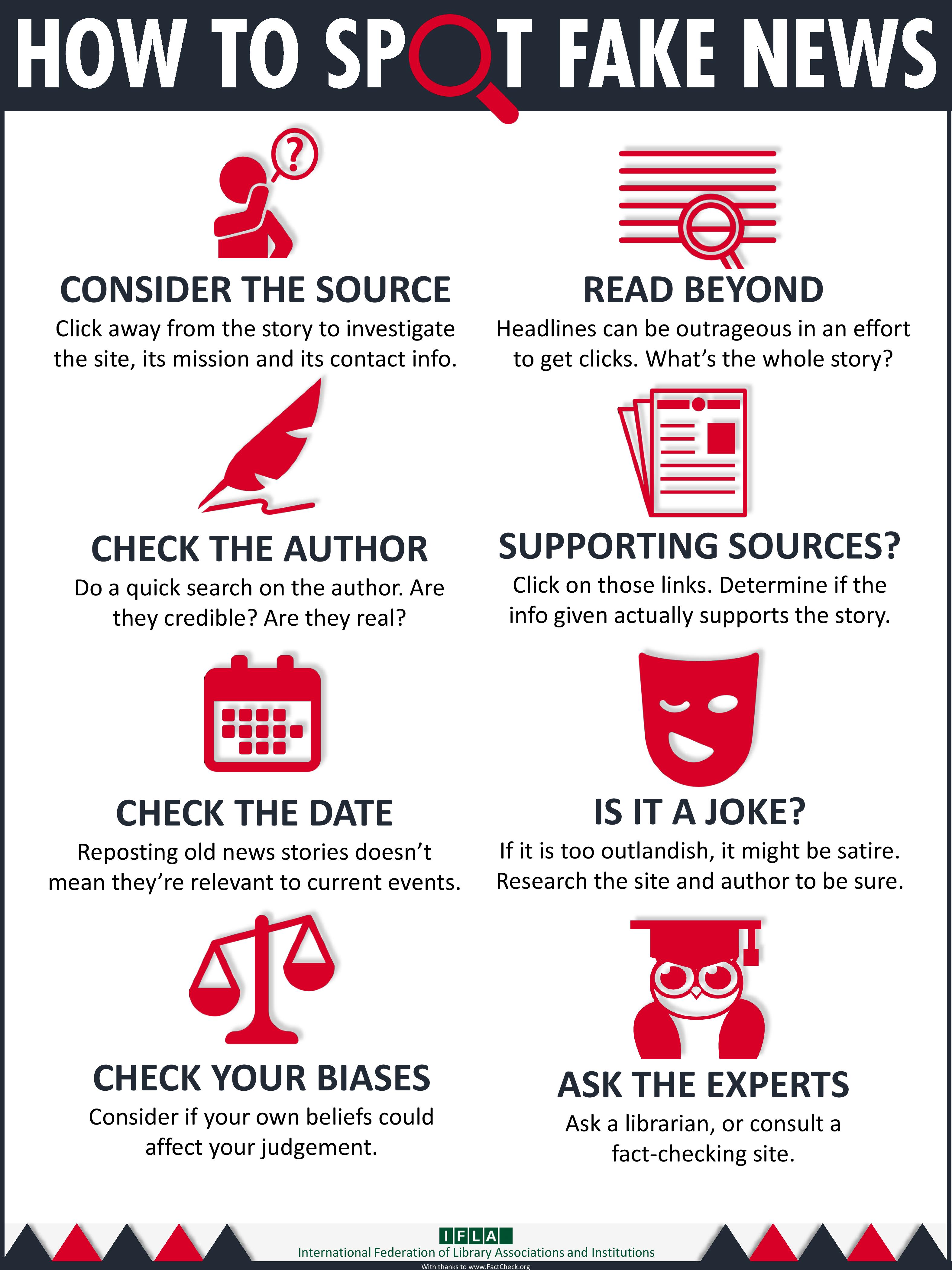
The International Federation of Library Associations and Institutions (IFLA) has a checklist to assist people to recognize fake news:[11]
- Consider the source (to understand its mission and purpose)
- Read beyond the headline (to understand the whole story)
- Check the authors (to see if they are real and credible)
- Assess the supporting sources (to ensure they support the claims)
- Check the date of publication (to see if the story is relevant and up to date)
- Ask if it is a joke (to determine if it is meant to be satire)
- Review your own biases (to see if they are affecting your judgment)
- Ask experts (to get confirmation from independent people with knowledge).
Reputation of the author
Ultimately, a judgement about fake news rests on the reputation of its author, and the reputation and editorial stance of a news organization or book publisher. Longevity is not in and of itself proof a publication or publishing house is an established reputable service. Newsweek magazine for instance, was once established as a "moderate" or right-leaning weekly news source to counter the perceived leftwing bias of Time magazine. It has since ceased publication as a print journal, and the name - Newsweek - was sold as an established, existing tradename, only to reappear online as a mainstream news source for some of the most outrageous left wing lunacy.
In the United States the New Republic, established before World War I, is considered the granddaddy of modern liberal thought, whereas the National Review established in the 1950s is considered its modern conservative counterpart. The Nation has long been deemed the voice of more marginalized progressive thinking. While staff management and editorial views have evolved over many decades, any author moving from one of these publications to another generally have professional reputations as traditional ethical journalists, unlike modern broadcast journalists, or what passes as "ethics" taught in some of the nation's most prestigious journalism and broadcast schools today.
Among book publishers, St. Martin's Press is considered a mainstream book publisher for Democrats which no other mainstream publisher would stake its reputation on, and Regnery is considered its Republican counterpart.
The challenge for young readers is to discern good, solid, factual reporting in the internet era, at a time when an explosion of anonymous blog sites are threatening the existence of a dying print and cable news broadcast industry.[12] Again the reputation of the author is all pervasive. This requires follow-up and holding the author (whether anonymous or a pseudonym) accountable, and not seeking confirmation bias in how a reader informs themself.
Holding the author accountable
As can be seen, the reputation of a news organization or individual journalist can change over time, to either improve or loose credibility.
The New Yorker for example, once had a reputation for vigorous fact checking. However, after such stories on the credibility of Wikipedia, its fictionalized account of the death of bin Laden, its hit piece on the person and character of American Sniper hero Chris Kyle, and it's partisan, sloppy, and outrageous attacks on Brett Kavanaugh, have called The New Yorker's viability as a reputable source into question.
Ronan Farrow, who writes for the New Yorker appeared as a bright and shining rising star in the field of investigative journalism, at a moment when public perception of journalists was at its lowest. Farrow fearlessly wrote about the deviant sexual predations of Democrat kingpins and mega-donors such as Harvey Weinstein and others, for which he won a Pulitzer Prize. Farrow even described the intimidation tactics wealthy predators use against female victims and himself by hired thugs and ex-intelligence agents to silence people. Farrow was a hero of the MeToo movement. Then Farrow tossed his reputation to the wind by signing his name to unsubstantiated smears, which his own reporting debunked, in a vicious partisan smear of Judge Brett Kavanaugh. Farrow sold out, and his actions now have the opposite effect of adding credibility to the defense and rehabilitation of Harvey Weinstein.
Wrap up smear
A wrap up smear,[13] also known as a circular reporting or an echo chamber, occurs when partisan sources leak false information to journalists then use those same published accounts to validate their claims.
Two instances in recent memory illustrate the technique: the Trump-Russia collusion hoax and the Kavanaugh smear. In Trump-Russia, a false allegation that Trump colluded with Russia was leaked by Democratic operatives to get news organizations to publicize the claim, then biased Obama administration employees used those news stories as supposed evidence to obtain FBI surveillance warrants on the Trump campaign.
CNN, the Washington Post, the New York Times and numerous other organizations reported fabricated information by anonymous sources throughout 2016, 2017, and 2018. The published reports became the basis of the Trump-Russia conspiracy hoax and FISA abuse scandal. When mainstream media published the false information, the Obama FBI, Justice Department, CIA and DNI used the fake news (originating with themselves) as supposed corroboration from "independent journalists" to begin investigations, interviews, perjury traps, seek warrants, perform Gang of Eight briefings, and appoint a Special Prosecutor to pursue political objectives.
In the Kavanaugh smear, false sexual abuse allegations were leaked by Senate Democrat committee staffers to produce sensationalized headlines and martial public pressure in an emotional cause.
Sen. Dianne Feinstein or a staffer leaked a letter from Dr. Christine Blasey Ford to the Washington Post alleging notes from a therapist and a polygraph exam were material evidence of a sexual assault, sparking a hue and cry on the Left for extended nomination hearings and FBI investigation of Judge Kavanaugh. The alleged "material evidence" was never provided to the FBI or Senate Judiciary Committee for examination and consideration, and the accuser caught in a series of conflicting sworn public statements.
Willing participants in the Russia collusion smear
These mainstream news organizations in one capacity or other were willing participants in the Trump-Russia collusion hoax. The plan to exonerate Hillary Clinton of criminal charges, sabotage Donald Trump's election chances, and later his presidency, originated with corrupt elements of the Obama administration in collusion with the Democratic party. Allies opposed to Trump's demand that NATO members give more to fund the alliance, and Russian sources feeding Democrats false information also contributed.
These uncorroborated allegations violated every tenet of traditional, respectable journalism. None of it would have been possible without the help of several global media organizations willingly publicizing the false narrative of Trump collusion with the Russian government.[14]
- CNN
- The New Yorker
- The New York Times
- The Washington Post
- BBC
- NBC
- BuzzFeed
- The Guardian
- Huffington Post
- Newsweek
- MSNBC
- Politico
- ABC
- Vanity Fair
- Slate
- McClatchy
- Yahoo News
- Mother Jones
Examples of fake news
While many examples of fake news appeared during Donald Trump's presidency, the problem existed long before his election.[15]
One of the more infamous examples of fake news was when former CBS News anchor Dan Rather used forgeries of the Killian Documents on George W. Bush's service record in order to sway the 2004 election, which resulted in his firing after being exposed. See Rathergate for more details.

Obama National Security Advisor Susan Rice appeared on the five major network Sunday talk shows to put out an official fake news narrative that a terrorist attack against Americans two months before a presidential election was only a peaceful demonstration that turned into a riot. Despite evidence the contrary, many mainstream news organizations adopted the fake news narrative as fact for its viewers and readers and branded skeptics as conspiracy theorists and racists who opposed a black president.
The most common example of fake news are the "click bait" ads that appear on social media sites saying "Hollywood prepares to say good-bye to [name of celebrity]" implying that the celebrity has just died. People then click on the ad to visit a website to learn about the celebrity's death, which boosts the number of page views on that site. However, the fake news will trend if more people start re-tweeting or sharing the item without visiting the underlying website in the belief that the celebrity has just died.
Fake news is frequently used by radical Islamic terrorists to recruit new adherents. The terrorists will either create or embellish fake news accounts of anti-Islamic acts to radicalize members in target populations. For example, terrorists would spread news accounts of people urinating on the Koran at U.S. military prisons. Another fake news item was that a U.S. company was hiring mercenaries to kill ISIS militants.[16] Again, the emotional impact of the fake news assured that it would spread quickly through social media.
According to FBI cyber experts, during the 2016 presidential election, Russians used armies of Twitter bots to spread fake news using accounts that seem to be Midwestern swing-voter Republicans.[17] Leading up to the March 15, 2017 election in the Netherlands, Russia was found to use social media to spread "fake news" to influence public opinion.[18]
One possible example of fake news was the announcement by the mainstream media that Fidel Castro died at age 90 on November 25, 2016.[19] In fact, the Obama Administration and major news outlets were likely aware that Castro had died of a terminal illness many years earlier. Indeed, Obama did not even mention, let alone visit, Castro during Obama's visit to Cuba in March 2016, and neither the president, vice-president, or other high-ranking elected official of the United States attended Castro's "funeral".
One fake news item from Freedom Daily in February 2017 was: "BREAKING: Federal Judge Just Officially Ruled CNN Is FAKE NEWS And Forces SHOCKING Punishment On Them!" However, this was a mis-reporting of a Georgia federal district court judge denying CNN's motion for summary judgment in a defamation action filed by a hospital executive against CNN. No "shocking punishment" was involved and the case will go to trial on the merits.[20]
A poorly-sourced February 4 Washington Post article claimed a feud existed between DHS Secretary John F. Kelly and Steve Bannon, when in fact, none existed. The article's author was forced to admit his error.[21] In June 2017, the Associated Press reported, and later corrected, a story that EPA Administrator Scott Pruitt met with Dow Chemical CEO Andrew Liveris – something which did not actually happen.[22]
In November 2017, The Washington Post claimed that the conservative Breitbart News created the nickname "Mr. Perfect" when referring to Jared Kushner, while in reality, Kushner's own companies created the nickname to promote themselves in China.[23] Also in November 2017, MSNBC's Morning Joe show was caught broadcasting a pre-taped post-Thanksgiving show while pretending on air to be broadcasting live.[24]
In April 2018, the Associated Press and The Washington Post falsely claimed that the NRA decided to ban concealed carry at an upcoming speech by Vice President Mike Pence at its convention, when it was actually the Secret Service that forced the organization to do so.[25]
CNN and fake news
In first half of 2017, CNN's market share relative to its competitors saw a marked decline.[26] In addition, it faced repeated losses of its credibility through its lapses of journalistic judgment and ethical lapses.[27] President Donald Trump publicly says CNN produces "fake news" and he also told a CNN reporter that CNN produces "very fake news".[28] Subsequently, CNN has been derided as being "FNN: Fake News Network".[29]
In May 2017, a CNN program claimed that Islam "has always been part of the American fabric" even as far back as the American Revolution, despite the apparent contradiction with the historical record.[30]
On March 28, 2018, CNN anchor Chris Cuomo falsely claimed that "no one [is] calling for Second Amendment repeal", even though, former Supreme Court Justice John Paul Stevens, among other left-wingers, had very recently and notably called for just that.[31]
Sometime before January 6, 2017, DNI James Clapper briefed opposition research talking points, manufactured by the Clinton campaign in the Steele dossier, to Jake Tapper of CNN. The salacious innuendo lacked verification and a " news hook" for CNN to report. Clapper instructed FBI Director James Comey to brief President-elect Trump on the allegations. Clapper immediately leaked the fact Trump had been briefed, creating the "news hook" CNN was looking for to publicize the existence of the Steele dossier. FBI counter-intelligence investigator Peter Strzok then used the fake news report to justify interviewing National Security Advisor Michael Flynn and lay a perjury trap,[32] thwarting the new president's foreign policy agenda. Clapper was rewarded with a job at CNN afterward.[33][34][35]
Deep state and fake news
- See also: Media intelligence complex
The mainstream media has worked with the deep state intelligence agencies to promote fake news regarding the supposed Trump-Russia scandal, [36] and the alleged Russian hacking of John Podesta and DNC emails.
2018 bomb hoax
Just when things looked desperate for Democrats with unhinged mobs responding to the party's leadership, CNN reported it had received a mail bomb addressed to John Brennan, who actually works for NBC. Nonetheless, CNN opened John Brennan's mail anyway, paused to take pictures of the alleged bomb resembling a Hollywood prop, before evacuting the building in a panic. Others recieved mailings as well.
Republicans were quick to condemn political violence,[37] unlike Democrat leaders, who were encouraging it.[38] President Trump vowed to use all the resources of the federal government to find who was responsible.
As soon as CNN feed into the news cycle that the bombs were active, giving breaking news reports a life of their own, within hours the Associated Press reported,
"tests have determined that a powder found inside an envelope delivered to CNN along with a pipe bomb was harmless."[39]
None of this stopped CNN and other mainstream sources from failing to clarify the facts, or whipping up anti-Trump hysteria.
None of the bombs were active, and the alleged bomber didn't know how to build a bomb anyway. The alleged bombs lacked a detonator device, were made with PVC tubing instead of lead, and packed with a harmless powder.[40]
Mangled statistics
A Washington Post article claimed that 4.2 percent of American children had witnessed a shooting[41] (this in one in 24). This was based on a survey question which they (deliberately? negligently?) misinterpreted:
- The actual question the researchers asked was, "At any time in (your child’s/your) life, (was your child/were you) in any place in real life where (he/she/you) could see or hear people being shot, bombs going off, or street riots?"[42]
So they mixed in "witnessed a shooting" with "heard a street riot", etc.
Liberal responses
When the term first came into common usages immediately after the 2016 elections, liberals, the mainstream media, and social media misapplied the term to make the false accusation that alternative news sources were "deliberately lying" to their readers, listeners, and viewers, and that these "lies" helped elect Donald Trump President of the United States. The liberal-pushed "fake news" accusations are a form of conspiracy theory.
The mainstream media itself publishes and promotes fake news stories appearing in nightly network newscasts, on its cable news channels, in its newspapers and on its websites (including Facebook).[43][44] When fake news sites misuse the "ABC News" logo[45] or are designed to appear to be sponsored by a TV news channel, the mainstream media may also appear to publish and promote fake news stories.
The mainstream media itself can be rife with government leaked fake news stories, such as a fictional Washington Post story that Russia hacked the U.S. power grid in 2016.[46] While leftists accuse conservatives of being behind fake news stories, the evidence shows the exact opposite, although fake news is designed to appeal to audiences all across the political spectrum.
WaPo
One attempt at broadening the meaning of the term as well as professing the likelihood of the use of what the term describes appeared on November 23, 2016 in the Washington Post:
| “ | In the wake of Donald Trump’s shock Nov. 2016 electoral victory, attention fell on the extent to which voter opinions could have been shaped by an epidemic of "fake news" websites that masqueraded as legitimate media outlets...Many fake stories proved more viral on social media than important articles from real sources.[47] | ” |
Ishaan Tharoor, the author who wrote the piece, lets the reader know that he assumes Trump's election win is so surprising (although it wasn't) that any explanation deserves to be looked at if the event has not been fully explained already. This would allow the subject which follows—his allegations of "fake news" being epidemic as well as his suggestions that they were isolated to media outlets that weren't "real sources" (by some unstated body's estimation)—to be plausible or even to be considered an especially good candidate as an explanation (to the uninformed), despite being unfounded or at least founded on exaggeration.
The election results prompted German Chancellor Angela Merkel, who represents a, establishment-globalist political party, to caution against "fake news" circulated in Social media:
| “ | Something has changed — as globalization has marched on, debate is taking place in a completely new media environment. Opinions aren’t formed the way they were 25 years ago ... Today we have fake sites, bots, trolls — things that regenerate themselves, reinforcing opinions with certain algorithms, and we have to learn to deal with them. I believe we should not underestimate what is happening in the context of the Internet and with digitalization; this is part of our reality ... We have regulations that allow for our press freedom, including the requirement for due diligence from journalists. Today we have many that experience a media that is based on very different foundations and is much less regulated.[47] | ” |
Facebook has also responded to the alleged problem by developing a system wherein readers can flag a post they find suspicious. Once flagged the post will be reviewed by a mainstream media representative, who decides whether the news is "real" or "fake."[48]
Snopes
On January 14, 2016, the Snopes website, itself considered a fake news site by some experts, published its "Snopes’ Field Guide to Fake News Sites and Hoax Purveyors"[16]
DFRLab definition
The Atlantic Council's Digital Forensic Research Lab which is partnering with Facebook to promote internet censorship defines fake news as
“deliberately presenting false information as news.” We differentiate this from disinformation, which we consider to be “deliberately spreading false information;” fake news is thus a subset of disinformation. We further distinguish it from misinformation, which we take to mean the unintentional spreading of false information.[49]
European Commission
In 2018, the European Commission proposed the creation of an "independent fact-checking network" that would fight what it views as "fake news." However, this network, if created, would be funded by left-wing organizations connected to George Soros.[50]
Conservative responses
"Undoubtedly the new main psyop against independent media is flooding the web with fake news, and mainstream media putting out fake news, and setting themselves up like a super-Snopes, to be the arbiter of what’s real and what’s not," countered Alex Jones from Infowars in the wake of criticism of the Alternative Media on the part of Democrat presidential candidate Hillary Clinton supporters following Trump's win.[51]
Answers in Genesis President Ken Ham noted that one of the most prominent and blatant examples of fake news is the media's treatment of evolution and an old Earth as undisputed scientific fact, even though numerous counterexamples exist to evolution and an old Earth.[52]
According to a 2017 Poynter Media Trust Survey, 44% of Americans believe the media creates "fake news" stories against Trump to make him look bad.[53] A Monmouth University poll released in April 2018 found that 77% of Americans believe the mainstream media reports fake news.[54]
Attempts at censorship
Melissa Zimdars, a far-Left professor had compiled a list of supposedly "fake and misleading" news websites that was heavily promoted in the Mainstream Media,[55] including Breitbart, Infowars, Twitchy, The Blaze, and Bizpac Review. Even liberals, such as Will Oremus on Slate.com, criticized the list and the term itself for being far too broad, unfairly targeting numerous sites, and being an overreaction.[56] Zimdars later removed her "Fake News" list, claiming she had been "harassed" and "doxed".[57]
A 2017 Yale University study found that flagging news stories as "fake news" is ineffective due to the general mistrust of the media by Americans that already exists.[58]
Hypocrisy
While liberals frequently accuse conservative or alternate media sites of being dishonest, they typically gloss over the massive failings of the mainstream media to accurately and fairly cover the news, as well as its own propensity to post and report fake news itself (such as the polls they released which falsely claimed that Hillary Clinton was "well ahead" of Donald Trump in the 2016 presidential election campaign in order to discourage conservative voters, despite the attendance figures of the Trump campaign rallies vs. the Clinton campaign rallies, which the mainstream media chose to ignore, proving otherwise). Although the polls may have correctly predicted Clinton's 3 million vote margin in the national popular vote, commenters ignored the fact that the election is determined state-by-state in the Electoral College. In fact, within days after Trump's victory in the election, Wikipedia's liberal editors propagated a far from neutral and heavily liberal-biased "Fake news website" article.[59]
See also
Notes
- ↑ https://youtu.be/UZLs11uSg-A
- ↑ Officials had determined within two hours, and the Associated Press reported that the alleged bombs were fake, however days later most prominent mainstream sources continued to allege the packages contained real bombs.
- ↑ Callan, Paul. Sue over fake news? Not so fast. Retrieved on April 6, 2017.
- ↑ "Tall Tale or Satire? Authors of So-Called "Fake News" Feel Misjudged". NBC News. http://www.nbcnews.com/news/us-news/tall-tale-or-satire-authors-so-called-fake-news-feel-n689421
- ↑ Fake News Watch. http://fakenewswatch.com/
- ↑ http://progressingamerica.blogspot.com/2012/02/journalism-and-manufacturing-of-consent.html
- ↑ http://progressingamerica.blogspot.com/2013/03/walter-lippmann-explains-how.html
- ↑ http://progressingamerica.blogspot.com/2017/01/who-is-founding-father-of-fake-news.html
- ↑ The Great George Bush Sr. "Grocery Scanner" Urban Legend Lives On. Media Research Center. Retrieved December 5, 2018.
- ↑ Nicas, Jack (November 14, 2016). "Google to bar fake-news websites from using its ad-selling software". Wall Street Journal.
- ↑ How to Spot Fake News (January 27, 2017).
- ↑ A prime example of Joseph Schumpeter's creative destruction.
- ↑ https://youtu.be/SMJdDwQlcc8
- ↑ https://themarketswork.com/wp-content/uploads/2018/10/inforgraphic-838x1024.jpg
- ↑ Miller, S.A. (December 30, 2018). 'Fake news' a real problem long before Trump era, media watchdogs say. The Washington Times. Retrieved December 31, 2018.
- ↑ 16.0 16.1 Snopes’ Field Guide to Fake News Sites and Hoax Purveyors (January 14, 2016). Retrieved on April 4, 2017.
- ↑ "How Russian Twitter Bots Pumped Out Fake News During The 2016 Election", NPR, April 3, 2017. Retrieved on April 4, 2017.
- ↑ "Russia spread fake news during Dutch election: report", Politico, April 4, 2017. Retrieved on April 4, 2017.
- ↑ https://www.cnn.com/2016/11/26/americas/fidel-castro-obit/
- ↑ "Did a Judge Rule That CNN Is 'Fake News'?", Snopes, Feb 17, 2017. Retrieved on April 5, 2017.
- ↑ Hayward, John (February 8, 2017). Fake News: DHS Secretary Calls WaPo ‘John Kelly-Steve Bannon Feud’ a ‘Fantasy Story’. Breitbart News. Retrieved May 18, 2017.
- ↑ Boyle, Matthew (June 30, 2017). Fake News: Associated Press Engulfed in CNN-Level Scandal as It Covers Up Invention of Imaginary Pruitt Meeting. Breitbart News. Retrieved July 1, 2017.
- ↑ Mason, Ian (November 27, 2017). WaPo Forgets Kushners Came Up with ‘Mr. Perfect’ on Their Own. Breitbart News. Retrieved November 27, 2017.
- ↑ Rodriguez, Katherine (November 26, 2017). Fake News: Morning Joe Caught Pretending Pre-Taped Day After Thanksgiving Show Was Live. Breitbart News. Retrieved November 27, 2017.
- ↑ Multiple references:
- Hawkins, Awr (April 30, 2018). Fake News: AP, WaPo Claim NRA Bans Guns at Mike Pence Speech. Breitbart News. Retrieved April 30, 2018.
- Adelmann, Bob (May 1, 2018). More Fake News: NRA Bans Guns at Its Own Convention! The New American. Retrieved May 1, 2018.
- Richardson, Bradford (April 30, 2018). AP issues correction on report that NRA banned guns for Mike Pence speech. The Washington Times. Retrieved April 30, 2018.
- Concha, Joe (April 30, 2018). AP corrects earlier report that NRA banned guns at Pence speech. The Hill. Retrieved April 30, 2018.
- ↑ Death Spiral: Along With Its Credibility, CNN Ratings Collapse, Daily Wire, 2017.
- ↑
- ↑ Trump to CNN: "Very Fake News"
- ↑ 'Fake News Network': Trump Blasts CNN for Retracted Russia Story, Fox News Network
- ↑ Pollak, Joel B. (May 29, 2017). CNN’s W. Kamau Bell: Islam Part of America’s Founding. Breitbart News. Retrieved May 29, 2017.
- ↑ Multiple references:
- Nolte, John (March 28, 2018). Fake News: CNN’s Cuomo Says ‘No One Calling for 2nd Amendment Repeal’ (They Are). Breitbart News. Retrieved March 28, 2018.
- Kugle, Andrew (March 28, 2018). CNN’s Cuomo: No One Is Calling for Repeal of Second Amendment. The Washington Free Beacon. Retrieved March 28, 2018.
- Adams, Becket (March 28, 2018). CNN host apparently unaware that people have indeed called for the repeal of the Second Amendment. Washington Examiner. Retrieved March 28, 2018.
- ↑ https://saraacarter.com/who-will-investigate-the-fbi-and-doj-top-secret-leaks-to-the-media/?utm=pushnami
- ↑ Russian Active Measures in the 2016 Election, House Permanent Sub Committee on Intelligence, March 22, 2017, pp. 107-108.
- ↑ Clapper Leaks Twice to CNN. Brennan Stands in the Shadows. A Russian Narrative is Born, Jeff Carlson, April 27, 2018.
- ↑ Anatomy of a Political Smear Confirmed – James Comey January Briefing Was Scripted by Clapper and Brennan To Create Media Narrative, by Sundance, April 20, 2018. theconservativetreehouse.com
- ↑ Jasper, William F. (April 25, 2017). Deep State and Fake News. The New American. Retrieved January 3, 2018.
- ↑ https://youtu.be/KwSGYUDQSuY
- ↑ https://m.imdb.com/title/tt9115480/
- ↑ 7:50 p.m.
A law enforcement official says tests have determined that a powder found inside an envelope delivered to CNN along with a pipe bomb was harmless.
The official wasn’t authorized to discuss the investigation publicly and spoke to The Associated Press on condition of anonymity.
New York City’s police commissioner said earlier Wednesday that the package sent to CNN’s offices in Manhattan contained a live explosive and an envelope containing white powder.
The FBI said the package was similar to explosives sent to former President Barack Obama, Hillary Clinton, former Attorney General Eric Holder and billionaire George Soros.
The package sent to CNN was addressed to former CIA Director John Brennan, a frequent guest on the channel. The official says that parcel contained no note or claim of responsibility.
cd5023f89feca Tom Hays, Associated Press, October 24, 2018. - ↑ https://www.nationalreview.com/news/cnn-pipe-bomb-white-powder-harmless-law-enforcement-report/
- ↑ 19 kids are shot every day in the United States
- ↑ How news organizations, including this one, unintentionally misinformed the public on guns
- ↑ Facebook is still figuring out how to tackle fake news. Tech Crunch (Feb 14, 2017). Retrieved on June 29, 2017.
- ↑ Barron, Rachel. "Even News Sites Fall for Fake News", American Journalism Review, April 3, 2017. Retrieved on June 29, 2017.
- ↑ "Breitbart Duped by Fake News (Again)", Snopes, September 1, 2016. Retrieved on April 5, 2017.
- ↑ Leetaru, Kalev, "'Fake News' And How The Washington Post Rewrote Its Story On Russian Hacking Of The Power Grid," Forbes, Jan 1, 2017.
- ↑ 47.0 47.1 Fake news threatens German election: Merkel
- ↑ https://www.wsj.com/articles/facebooks-fake-fix-for-fake-news-1481932361
- ↑ https://medium.com/dfrlab/fake-news-defining-and-defeating-43830a2ab0af
- ↑ Tomlinson, Chris (April 28, 2018). European Union Advocates For Soros-Funded ‘Independent Fact Checkers’ to Combat ‘Fake News’. Breitbart News. Retrieved April 28, 2018.
- ↑ Finally, Someone Is Standing Up to Fake News: Infowars
- ↑ Ham, Ken (March 21, 2017). The Real Fake News. Answers in Genesis. Retrieved March 21, 2017.
- ↑ Richardson, Bradford (December 28, 2017). ‘Fake News’: Half of all Americans believe the media make up anti-Trump stories. The Washington Times. Retrieved December 29, 2017.
- ↑ Multiple references:
- Manchester, Julia (April 2, 2018). More than 3 in 4 believe traditional media reports ‘fake news’: poll. The Hill. Retrieved April 2, 2018.
- Persons, Sally (April 2, 2018). Over 70 percent of Americans see media as ‘fake news,’ a Monmouth University poll shows. The Washington Times. Retrieved April 2, 2018.
- Church, Nate (April 2, 2018). Poll: 77 Percent Believe Traditional Media Guilty of Fake News. Breitbart News. Retrieved April 2, 2018.
- Lima, Cristiano (April 2, 2018). Poll: 77 percent say major news outlets report 'fake news'. Politico. Retrieved April 2, 2018.
- Byas, Steve (April 4, 2018). Poll: Public Convinced That Media Reports Fake News to Advance Their Own Agenda. The New American. Retrieved April 4, 2018.
- ↑ BREAKING: Liberals Create List of "Fake" News Websites Including: Breitbart, Infowars, Zerohedge, Twitchy, The Blaze
- ↑ Oremus, Will (December 6, 2016). Stop Calling Everything “Fake News”. Slate.com. Retrieved December 8, 2016.
- ↑ Dr Melissa Zimdars removes fake news list and claims she was ‘harassed’
- ↑ Church, Nate (September 12, 2017). Study: Flagging Stories as ‘Fake News’ Ineffective; People No Longer Trust Media. Breitbart News. Retrieved September 13, 2017.
- ↑ "Fake news website" article at Wikipedia, December 2, 2016.

External links
- What is Fake News video by Prager University
- Forbes: Fake News Is So Un-civil
- Fake News, by Bill Whittle
- FAKE NEWS: CNN Ties MILO to White Nationalists Despite Explicit Rejection of Racism at Breitbart News Network
- Fakehatecrimes.org. A database of reported instances of fake hate crimes.
- 6 Quick Ways to Spot Fake News