Difference between revisions of "Historical Painting"
| Line 1: | Line 1: | ||
[[File:Alma Tadema Egyptian Chess Players 1865.jpg|thumb|[[Sir Lawrence Alma Tadema]], Egyptian Chess Players, 1865.]] | [[File:Alma Tadema Egyptian Chess Players 1865.jpg|thumb|[[Sir Lawrence Alma Tadema]], Egyptian Chess Players, 1865.]] | ||
| − | '''Historical Painting''' is a branch of [[painting]] that represents significant events of [[history]], [[religion]] or [[literature]]. Their subjects can be taken from the [[Bible]], from mythology or other forms of secular literature, from historical events; or they can be allegories. [http://www.nationalgallery.org.uk/paintings/glossary/history-painting] It was viewed as the most important of the painting genres from about the 16th century until [[Paul Cezanne]]'s era. It was a category of art in the old academic tradition, based on the values of ancient Greece and Rome. [http://arthistory.about.com/od/glossary_h/a/h-history-painting.htm] History Painting and Historical Painting, both terms are still often used in a confusing manner. Historical painting is generally understood to have diclined dramatically during the [[Victorian | + | '''Historical Painting''' is a branch of [[painting]] that represents significant events of [[history]], [[religion]] or [[literature]]. Their subjects can be taken from the [[Bible]], from mythology or other forms of secular literature, from historical events; or they can be allegories. [http://www.nationalgallery.org.uk/paintings/glossary/history-painting] It was viewed as the most important of the painting genres from about the 16th century until [[Paul Cezanne]]'s era. It was a category of art in the old academic tradition, based on the values of ancient Greece and Rome. [http://arthistory.about.com/od/glossary_h/a/h-history-painting.htm] History Painting and Historical Painting, both terms are still often used in a confusing manner. Historical painting is generally understood to have diclined dramatically during the [[Victorian Art|Victorian period]]. [https://docs.google.com/viewer?a=v&q=cache:9MoshlkHpFYJ:www.manchesteruniversitypress.co.uk/uploads/docs/s1_23.pdf+Paul+Barlow+Professor&hl=en&gl=uk&pid=bl&srcid=ADGEESjcjev4zZWsyXRk2Qb0TAbQHs52uwq7cmMmRBnlY97ah2aGpKYtVsGu-QOIeMciCrUfH45N1knB0NFikusclJybCwP5TMoAMaQJNS8TPzZFOBvOQvtUrmEPUT--Kqw8tmhvKr8G&sig=AHIEtbSRK7DWVGwdLbYF38jvUAihfTFS0Q] |
Revision as of 00:06, May 30, 2015

Historical Painting is a branch of painting that represents significant events of history, religion or literature. Their subjects can be taken from the Bible, from mythology or other forms of secular literature, from historical events; or they can be allegories. [1] It was viewed as the most important of the painting genres from about the 16th century until Paul Cezanne's era. It was a category of art in the old academic tradition, based on the values of ancient Greece and Rome. [2] History Painting and Historical Painting, both terms are still often used in a confusing manner. Historical painting is generally understood to have diclined dramatically during the Victorian period. [3]


William Blake, The Penance of Jane Shore, 1793.

The Declaration of Independence by John Trumbull, 1818.

Diogenes by John William Waterhouse, 1882.

Tristan and Isolde with the Potion by John William Waterhouse, 1916.


Creation of Adam by Michelangelo, 1512.
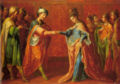
Los desposorios de José y Asenet by Cristóbal de Villalpando.

Jacques-Louis David, The Death of Seneca, 1773.

Jacques-Louis David, The Death of Socrates, 1787.

La liberte guidant le peuple by Eugene Delacroix, 1830.


Dido building Carthage by William Turner, 1815.
See also


- The Death of General Warren at the Battle of Bunker Hill by John Trumbull, 1786.
External links

- The Death of History Painting in Nineteenth-Century Art?
- History painting. Princeton University.

