Difference between revisions of "Rome"
(Minor syntax corrections. Forum is not a building, but an area, so removed it from "famous buildings" note and replaced it with the Pantheon, an actual structure.) |
m (Reverted edits by ILoveNazisHH (talk) to last revision by Korvex) |
||
| (37 intermediate revisions by 13 users not shown) | |||
| Line 1: | Line 1: | ||
| − | [[Image:rome2.jpg| | + | [[Image:rome2.jpg|right|thumb|300px|The Piazza of St. Peter's.]] |
| − | '''Rome''' (Italian ''Roma'') is the capital city of [[Italy]], as well as | + | '''Rome''' ([[Italian language|Italian]]: ''Roma'') is the capital city of [[Italy]], as well as its most populous city. Rome is located on the western side of the Italian Peninsula, on the east of the [[Tiber River]]. The total population of Rome is approximately 2.8 million. The territory of the independent state of [[Vatican City|the Vatican]] is entirely contained within Rome. It is the third most-visited tourist destination in the EU.<ref>[http://www.euromonitor.com/Top_150_City_Destinations_London_Leads_the_Way]</ref> |
| + | ==History== | ||
| + | Rome is best known as the capital of the [[Roman Republic]] and [[Roman Empire]], and was quite possibly the most important city in the world during the [[Pax Romana]]. | ||
| − | + | [[File:Rome1.jpg|right|200px]] | |
| − | + | <blockquote> | |
| + | Rome has been an urban centre for more than 2000 years. Most of the monuments of the city's history still stand. The historical centre is a small area, mostly located on the eastern (left) bank of the [[Tiber]], enclosing the traces of a neverending history that dates back to the oldest times and was steadily rennovated by great Roman characters, such as the emperors, nobles, wealthy families, and popes. Each of them left an indelible and lasting sign of its importance. That is why the monuments of Rome's past greatness are, for the most part, within the historical centre, in stark contrast to the modern districts. Having been for long the major city of Europe, Rome has become an unparalleled repository of monuments of all the periods, from the [[Etruscan]] to modern times. [http://www.aboutroma.com/history-of-rome/modern-rome.html] | ||
| + | </blockquote> | ||
| − | ==See | + | ==Architecture== |
| + | Famous buildings in Rome include the [[Colosseum]], [[Saint Peter's Basilica]], and the Pantheon. Rome has more fountains than any other city in the world. | ||
| + | [[File:Roma. Basilica San Ambrosio y San Carlos.jpg|thumb|left|Basilica of St. Ambrosio and St. Carlos.]] | ||
| + | The Christian churches in Rome are several hundred and their history is intertwined with the history of religious, social and artistic city. The most imporant are: the church of San Giovanni in Laterano, the basilic of San Paolo and the Basilic of Saint Paul Outside the Walls and the basilica of Santa Maria Maggiore. <blockquote> | ||
| + | Of all the Rome City fountains, the Trevi Fountain is by far the most famous. With its impressive [[statue]] of Triton in all of his glory, one would be shocked to learn that a Pope actually commissioned this great piece of art. Clement XII wanted to rebuild the area in which the fountain is now in, and the fountain alone took over thirty years to finish. It is a breathtaking site that still holds visitors in awe of the fusion of marble and art. (Source: EzineArticles.com) | ||
| + | </blockquote> | ||
| + | |||
| + | |||
| + | <center> | ||
| + | <gallery perrow="5"> | ||
| + | File:Colloseum.gif|Colloseum. | ||
| + | File:Pantheon Rome.jpg|Pantheon Rome. | ||
| + | File:Vittoriano Monument Rome.jpg|Vittoriano Monument. | ||
| + | File:Il Gesu.jpg|Il Gesu. | ||
| + | File:Santa Maria degli Angeli Rome.jpg|Santa Maria degli Angeli. | ||
| + | </gallery> | ||
| + | |||
| + | |||
| + | <gallery> | ||
| + | File:Arco di Tito Rome.jpg|Arco di Tito. | ||
| + | File:Altar St Peter the Vatican.jpg|St. Peter's Basilica. | ||
| + | File:Bernini baldacchino.jpg|Bernini's baldacchino at Saint Peter's. | ||
| + | </gallery> | ||
| + | </center> | ||
| + | |||
| + | <blockquote> | ||
| + | Rome owes its Baroque aspect of today to the 17th–century popes Urban VIII, Innocent X, and Alexander VII, who became patrons of the greatest exponents of this style, such as [[Gianlorenzo Bernini]] and Francesco Borromini. [http://www.aboutroma.com/history-of-rome/baroque.html] | ||
| + | </blockquote> | ||
| + | |||
| + | ==See also== | ||
[[Image:Trevi.jpg|thumb|Trevi Fountain]] | [[Image:Trevi.jpg|thumb|Trevi Fountain]] | ||
| + | *[[List of World Heritage Sites in Europe and North America]] | ||
*[[Ancient Rome]] | *[[Ancient Rome]] | ||
| + | *[[Roman painting]] | ||
| + | *[[Art cities]] | ||
| + | *[[Gianlorenzo Bernini]] | ||
| − | ==External | + | ==External links== |
*[http://www.romereborn.virginia.edu/ 3-D Visualization of the Ancient City of Rome from the University of Virginia] | *[http://www.romereborn.virginia.edu/ 3-D Visualization of the Ancient City of Rome from the University of Virginia] | ||
*[http://www.crystalinks.com/rome.html Ancient Rome] | *[http://www.crystalinks.com/rome.html Ancient Rome] | ||
| + | *[http://www.activitaly.it/musei/ Museums in Rome] List of all the most important museums in Rome. | ||
| + | *[http://www.citrag.it/roma/eng_home.htm History and Civilization of the Eternal City] | ||
| + | |||
| + | == References == | ||
| + | <references/> | ||
[[Category:Italian Cities and Towns]] | [[Category:Italian Cities and Towns]] | ||
[[Category:Capital Cities]] | [[Category:Capital Cities]] | ||
| + | [[Category:Renaissance]] | ||
| + | [[Category:Ancient Rome]] | ||
| + | [[Category:Catholic Church]] | ||
| + | [[Category:Italian History]] | ||
| + | [[Category:Urban History]] | ||
| + | [[Category:Biblical Places]] | ||
| + | |||
| + | {{Bible Cities}} | ||
Latest revision as of 23:09, September 24, 2020

Rome (Italian: Roma) is the capital city of Italy, as well as its most populous city. Rome is located on the western side of the Italian Peninsula, on the east of the Tiber River. The total population of Rome is approximately 2.8 million. The territory of the independent state of the Vatican is entirely contained within Rome. It is the third most-visited tourist destination in the EU.[1]
History
Rome is best known as the capital of the Roman Republic and Roman Empire, and was quite possibly the most important city in the world during the Pax Romana.

Rome has been an urban centre for more than 2000 years. Most of the monuments of the city's history still stand. The historical centre is a small area, mostly located on the eastern (left) bank of the Tiber, enclosing the traces of a neverending history that dates back to the oldest times and was steadily rennovated by great Roman characters, such as the emperors, nobles, wealthy families, and popes. Each of them left an indelible and lasting sign of its importance. That is why the monuments of Rome's past greatness are, for the most part, within the historical centre, in stark contrast to the modern districts. Having been for long the major city of Europe, Rome has become an unparalleled repository of monuments of all the periods, from the Etruscan to modern times. [2]
Architecture
Famous buildings in Rome include the Colosseum, Saint Peter's Basilica, and the Pantheon. Rome has more fountains than any other city in the world.

The Christian churches in Rome are several hundred and their history is intertwined with the history of religious, social and artistic city. The most imporant are: the church of San Giovanni in Laterano, the basilic of San Paolo and the Basilic of Saint Paul Outside the Walls and the basilica of Santa Maria Maggiore.
Of all the Rome City fountains, the Trevi Fountain is by far the most famous. With its impressive statue of Triton in all of his glory, one would be shocked to learn that a Pope actually commissioned this great piece of art. Clement XII wanted to rebuild the area in which the fountain is now in, and the fountain alone took over thirty years to finish. It is a breathtaking site that still holds visitors in awe of the fusion of marble and art. (Source: EzineArticles.com)

Colloseum.

Pantheon Rome.

Vittoriano Monument.

Il Gesu.

Santa Maria degli Angeli.


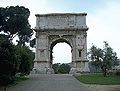
Arco di Tito.

St. Peter's Basilica.

Bernini's baldacchino at Saint Peter's.


Rome owes its Baroque aspect of today to the 17th–century popes Urban VIII, Innocent X, and Alexander VII, who became patrons of the greatest exponents of this style, such as Gianlorenzo Bernini and Francesco Borromini. [3]
See also

- List of World Heritage Sites in Europe and North America
- Ancient Rome
- Roman painting
- Art cities
- Gianlorenzo Bernini
External links
- 3-D Visualization of the Ancient City of Rome from the University of Virginia
- Ancient Rome
- Museums in Rome List of all the most important museums in Rome.
- History and Civilization of the Eternal City
References