|
|
| (61 intermediate revisions by 27 users not shown) |
| Line 1: |
Line 1: |
| − | {{sprotect}}
| + | [[Image:rome2.jpg|right|thumb|300px|The Piazza of St. Peter's.]] |
| − | [[Image:Rome panorama sb1.jpg|center|600px|thumb|Panorama over Rome]] | + | '''Rome''' ([[Italian language|Italian]]: ''Roma'') is the capital city of [[Italy]], as well as its most populous city. Rome is located on the western side of the Italian Peninsula, on the east of the [[Tiber River]]. The total population of Rome is approximately 2.8 million. The territory of the independent state of [[Vatican City|the Vatican]] is entirely contained within Rome. It is the third most-visited tourist destination in the EU.<ref>[http://www.euromonitor.com/Top_150_City_Destinations_London_Leads_the_Way]</ref> |
| − | {{Otheruses}}
| + | ==History== |
| − | {{Infobox City
| + | Rome is best known as the capital of the [[Roman Republic]] and [[Roman Empire]], and was quite possibly the most important city in the world during the [[Pax Romana]]. |
| − | |official_name = Comune di Roma
| |
| − | |established_title = Founded | |
| − | |established_date = [[21 April]] [[753 BC]]
| |
| − | |nickname = The Eternal City
| |
| − | |motto = [[SPQR]]: Senatus PopulusQue Romanus
| |
| − | |website = http://www.comune.roma.it
| |
| − | |image_skyline = Colosseum-2003-07-09.jpg
| |
| − | |image_flag = Flag of Rome.svg
| |
| − | |image_seal = Coat of arms of Rome.png
| |
| − | |image_map = Roma posizione 3.png
| |
| − | |map_caption = Location of the city of Rome (yellow) within the [[Province of Rome]] (red) and region of [[Lazio]] (grey)
| |
| − | |subdivision_type = [[Regions of Italy|Region]]
| |
| − | |subdivision_type1 = [[Provinces of Italy|Province]]
| |
| − | |subdivision_name = [[Lazio]]
| |
| − | |subdivision_name1 = [[Province of Rome]]
| |
| − | |leader_title = [[Mayor of Rome|Mayor]]
| |
| − | |leader_name = [[Walter Veltroni]]
| |
| − | |area_magnitude = 1 E8
| |
| − | |TotalArea_sq_mi = 580
| |
| − | |area_total = 1285
| |
| − | |population_footnotes = <ref>http://demo.istat.it/pop2005 - [[Istituto Nazionale di Statistica|ISTAT]] demographics</ref>
| |
| − | |population_as_of = [[1 January]] 2005
| |
| − | |population_total = 2553873 *
| |
| − | or 2817293 **
| |
| − | |population_urban = 3831959
| |
| − | |area_urban = 5352
| |
| − | |UrbanArea_sq_mi = 2066
| |
| − | |population_metro = 5304778
| |
| − | |population_density = 1985* or 2197**
| |
| − | |population_density_mi2 =5141* or 5690**
| |
| − | |population_note = *(ISTAT); **(Municipal Register Office)
| |
| − | |timezone = [[Central European Time|CET]]
| |
| − | |utc_offset = +1
| |
| − | |timezone_DST =
| |
| − | |utc_offset_DST =
| |
| − | |latd = 41
| |
| − | |latm = 54
| |
| − | |lats =
| |
| − | |latNS = N
| |
| − | |longd = 12
| |
| − | |longm = 30
| |
| − | |longs =
| |
| − | |longEW = E
| |
| − | |elevation = +20
| |
| − | |elevation_ft = 66
| |
| − | |postal_code_type = Postal codes
| |
| − | |postal_code = 00121 to 00199
| |
| − | |area_code = 06
| |
| − | |footnotes = Patron saints: [[Saint Peter]] and [[Paul of Tarsus|Saint Paul]]
| |
| − | }}
| |
| − | {{Infobox World Heritage Site
| |
| − | | WHS = Historic Centre of [[Rome]], the [[Properties of the Holy See#Outside Vatican City but inside Rome|Properties of the Holy See in that City Enjoying Extraterritorial Rights]] and [[Basilica of Saint Paul Outside the Walls|San Paolo Fuori le Mura]]
| |
| − | | Image = [[Image:RomaCastelSantAngelo.jpg|300px|Rome - Castel Sant'Angelo]]
| |
| − | | State Party = {{ITA}} and [[Image:Flag of the Vatican City.svg|22px]] [[Holy See]]
| |
| − | | Type = Cultural
| |
| − | | Criteria = i, ii, iii, iv, vi
| |
| − | | ID = 91
| |
| − | | Region = [[List of World Heritage Sites in Europe|Europe and North America]]
| |
| − | | Year = 1980
| |
| − | | Session = 4th
| |
| − | | Extension = 1990
| |
| − | | Link = http://whc.unesco.org/en/list/91
| |
| − | }}
| |
| | | | |
| − | '''Rome''' ([[Italian language|Italian]]: ''Roma'') is the [[capital|capital city]] of [[Italy]] and of the [[Lazio]] (Latin "Latium") region, as well as the country's largest and most populous ''[[comune]]'', with about 2.8 million residents (3.8 million considering the whole urbanised area, as represented by the [[Province of Rome]]). It is located in the central-western portion of the [[Italian peninsula]], where the river [[Aniene]] joins the [[Tiber]]. As one of the largest cities in the [[European Union]], the ''Comune di Roma'' has a [[gross domestic product]] of €97 billion in the year 2005, equal to 6.7% of Italy's GDP — the highest proportion of GDP produced by any single Italian ''comune''. The current [[Mayor of Rome]] is [[Walter Veltroni]].
| + | [[File:Rome1.jpg|right|200px]] |
| | | | |
| − | According to legend, the city of Rome was founded by the twins [[Romulus and Remus]] on [[April 21]], [[753 BC]]. Archaeological evidence supports claims that Rome was inhabited since the [[8th century BC]] and earlier.<ref>[http://www.physorg.com/news68303594.html 3,000-year-old skeleton found in Rome]; [http://news.scotsman.com/international.cfm?id=801632006 Perfect Bronze Age skeleton in the heart of Rome]; [http://www.washingtonpost.com/wp-dyn/content/article/2006/05/30/AR2006053001113.html Ancient Female Skeleton Found in Rome - washington post]</ref> The city was the cradle of [[ancient Rome|Roman civilization]] that produced the largest and longest-lasting empire of classical antiquity.{{Fact|date=February 2007}} The city was pivotal and responsible for the spread of [[Greco-Roman]] culture that endures to this day. Rome is also identified with the [[Catholic Church]] and the holders of its [[episcopal see|episcopal seat]] are the [[pope]]s. An [[enclave]] of Rome is the State of the [[Vatican City]], the sovereign territory of the [[Holy See]] and smallest nation in the world.
| + | <blockquote> |
| | + | Rome has been an urban centre for more than 2000 years. Most of the monuments of the city's history still stand. The historical centre is a small area, mostly located on the eastern (left) bank of the [[Tiber]], enclosing the traces of a neverending history that dates back to the oldest times and was steadily rennovated by great Roman characters, such as the emperors, nobles, wealthy families, and popes. Each of them left an indelible and lasting sign of its importance. That is why the monuments of Rome's past greatness are, for the most part, within the historical centre, in stark contrast to the modern districts. Having been for long the major city of Europe, Rome has become an unparalleled repository of monuments of all the periods, from the [[Etruscan]] to modern times. [http://www.aboutroma.com/history-of-rome/modern-rome.html] |
| | + | </blockquote> |
| | | | |
| − | Rome, ''Caput mundi'' ("capital of the world"), ''la Città Eterna'' ("the Eternal City"), ''Limen Apostolorum'' ("threshold of the Apostles"), ''la città dei sette colli'' ("the city of the [[Seven hills of Rome|seven hills]]") or simply ''l'Urbe'' ("the City"),<ref>[http://www.demauroparavia.it/125134 s.v. "Urbe"], [[De Mauro Paravia]].</ref> is thoroughly modern and cosmopolitan. As one of the few major European cities that escaped [[World War II]] relatively unscathed, central Rome remains essentially [[Renaissance]] and [[Baroque]] in character. The Historic Centre of Rome is listed by [[UNESCO]] as a [[World Heritage Site]]<ref>http://whc.unesco.org/en/list/91 - Entry about Rome on the official website of the [[UNESCO]] World Heritage Centre</ref>. | + | ==Architecture== |
| | + | Famous buildings in Rome include the [[Colosseum]], [[Saint Peter's Basilica]], and the Pantheon. Rome has more fountains than any other city in the world. |
| | + | [[File:Roma. Basilica San Ambrosio y San Carlos.jpg|thumb|left|Basilica of St. Ambrosio and St. Carlos.]] |
| | + | The Christian churches in Rome are several hundred and their history is intertwined with the history of religious, social and artistic city. The most imporant are: the church of San Giovanni in Laterano, the basilic of San Paolo and the Basilic of Saint Paul Outside the Walls and the basilica of Santa Maria Maggiore. <blockquote> |
| | + | Of all the Rome City fountains, the Trevi Fountain is by far the most famous. With its impressive [[statue]] of Triton in all of his glory, one would be shocked to learn that a Pope actually commissioned this great piece of art. Clement XII wanted to rebuild the area in which the fountain is now in, and the fountain alone took over thirty years to finish. It is a breathtaking site that still holds visitors in awe of the fusion of marble and art. (Source: EzineArticles.com) |
| | + | </blockquote> |
| | | | |
| − | ==History and demographics==
| |
| − | {{main|History of Rome}}
| |
| | | | |
| − | ===From founding to Empire=== | + | <center> |
| − | [[Image:She-wolf_suckles_Romulus_and_Remus.jpg|left|thumb|220px|The ancient [[Etruscan civilization|Etruscan]] [[bronze]] [[Capitoline Wolf]] suckles the infant twins [[Romulus and Remus]]; the twins were added in the late [[15th century]], probably by [[Antonio Pollaiolo]].]] The [[founding of Rome]] is shrouded in legend such as the story of Romulus and Remus where ultimately Remus dies in the end, but archeological evidence supports the theory that Rome grew from pastoral settlements on the [[Palatine Hill]] and in the area of the future [[Roman Forum]], coalescing into a city in the [[8th century BC]]. That city developed into the capital of the [[Roman Kingdom]] (ruled by a succession of seven kings, according to tradition), [[Roman Republic]] (from [[510 BC]], governed by the [[Roman Senate|Senate]]), and finally the [[Roman Empire]] (from [[31 BC]], ruled by an [[Roman Emperor|Emperor]]); this success depended on military conquest, commercial predominance, as well as selective assimilation of neighbouring civilizations, most notably the [[Etruscans]] and [[Ancient Greece|Greeks]]. Roman dominance expanded over most of [[Europe]] and the shores of the [[Mediterranean sea]], while its population surpassed one million inhabitants. For almost a thousand years, Rome was the most politically important, richest and largest city in the [[Western world]], and remained so after the Empire started to [[Decline of the Roman Empire|decline]] and was split, even if it ultimately lost its capital status to [[Milan]] and then [[Ravenna]], and was surpassed in prestige by the [[Eastern Roman Empire|Eastern]] capital [[Constantinople]].
| + | <gallery perrow="5"> |
| | + | File:Colloseum.gif|Colloseum. |
| | + | File:Pantheon Rome.jpg|Pantheon Rome. |
| | + | File:Vittoriano Monument Rome.jpg|Vittoriano Monument. |
| | + | File:Il Gesu.jpg|Il Gesu. |
| | + | File:Santa Maria degli Angeli Rome.jpg|Santa Maria degli Angeli. |
| | + | </gallery> |
| | | | |
| − | ===Fall of the Empire and rise of the Papacy===
| |
| − | With the rise of [[early Christianity]], the [[Bishop of Rome]] gained religious as well as political importance, eventually becoming known as the [[Pope]] and establishing Rome as the centre of the Catholic Church. After the [[Sack of Rome (410)]] by [[Alaric I]] and the [[fall of the Western Roman Empire]] in [[476]], Rome alternated between [[Byzantine Empire|Byzantine]] rule and plundering by [[barbarian|Germanic barbarians]]. Its population declined to a mere 20,000 during the [[Early Middle Ages]], reducing the sprawling city to groups of inhabited buildings interspersed among large areas of ruins and vegetation. Rome remained nominally part of the Byzantine Empire until 751 when the Lombards finally abolished the [[Exarchate of Ravenna]]. In 756, [[Pepin the Short]] gave the pope temporal jurisdiction over Rome and surrounding areas, thus creating the Papal States.
| |
| | | | |
| − | Rome remained the capital of the [[Papal States]] until its annexation into the Kingdom of Italy in 1870; the city became a major pilgrimage site during the [[Middle Ages]] and the focus of struggles between the Papacy and the [[Holy Roman Empire]] starting with [[Charlemagne]], who was crowned its first emperor in Rome on Christmas of 800 by [[Pope Leo III]]. Apart from brief periods as an independent city during the Middle Ages, Rome kept its status of Papal capital and "holy city" for centuries, even when the Pope briefly relocated to [[Avignon]] ([[1309]]–[[1337]]). While no longer politically powerful, as tragically shown by the brutal [[Sack of Rome (1527)|sack of 1527]], the city flourished as a hub of cultural and artistic activity during the [[Renaissance]], under the patronage of the Papal court. Population rose again and reached 100,000 during the [[17th century]], but Rome ultimately lagged behind the rest of the European capitals over the subsequent centuries, being largely busy in the [[Counter-Reformation]] process. | + | <gallery> |
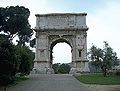
| | + | File:Arco di Tito Rome.jpg|Arco di Tito. |
| | + | File:Altar St Peter the Vatican.jpg|St. Peter's Basilica. |
| | + | File:Bernini baldacchino.jpg|Bernini's baldacchino at Saint Peter's. |
| | + | </gallery> |
| | + | </center> |
| | | | |
| − | ===From unification to Fascism===
| + | <blockquote> |
| − | Caught up in the nationalistic turmoils of the [[19th century]] and having twice gained and lost a short-lived independence, Rome became the focus of the hopes for Italian unification, as propelled by the [[Kingdom of Italy]] ruled by King [[Vittorio Emanuele II]]; after the [[France|French]] protection was lifted in [[1870]], royal troops stormed the city, and Rome was declared capital of the newly unified Italy in [[1871]].
| + | Rome owes its Baroque aspect of today to the 17th–century popes Urban VIII, Innocent X, and Alexander VII, who became patrons of the greatest exponents of this style, such as [[Gianlorenzo Bernini]] and Francesco Borromini. [http://www.aboutroma.com/history-of-rome/baroque.html] |
| − | After a victorious [[World War I]], Rome witnessed the rise to power of [[Italian fascism]] guided by [[Benito Mussolini]], who [[March on Rome|marched]] on the city in [[1922]], eventually declared a new [[Italian Empire|Empire]] and allied Italy with [[Nazi Germany]]. This was a period of rapid growth in population, from the 212,000 people at the time of unification to more than 1,000,000, but this trend was halted by [[World War II]], during which Rome was damaged by both [[Allies of World War II|Allied forces]] [[Bombing of Rome in World War II|bombing]] and Nazi occupation; after the execution of Mussolini and the end of the war, a [[1946]] referendum abolished the monarchy in favour of the [[Italian Republic]].
| + | </blockquote> |
| − | | |
| − | ===Republican times===
| |
| − | Rome grew momentously after the war, as one of the driving forces behind the "[[Italian economic miracle]]" of post-war reconstruction and modernisation. It became a fashionable city in the [[1950s]] and early [[1960s]], the years of "'la Dolce Vita'" ("the sweet life"), and a new rising trend in population continued till the mid-[[1980s]], when the ''comune'' had more than 2,800,000 residents; after that, population started to slowly decline as more residents moved to nearby ''comuni''; this has been attributed to their perceiving a decrease in the quality of life,{{Fact|date=February 2007}} especially because of the continuously [[traffic congestion|jammed traffic]] and the worsening [[pollution]] it brings about.
| |
| − | | |
| − | ==Geography and climate==
| |
| − | ===Location===
| |
| − | Rome is in the Lazio region of central Italy, at the confluence of the [[Aniene]] and [[Tiber]] (Italian: ''Tevere'') rivers. Although the city centre is about 24 kilometres inland from the [[Tyrrhenian Sea]], the city territory extends to the very shore, where the south-western [[Ostia Antica (district)|Ostia]] district is located. The [[altitude]] of Rome ranges from 13 metres [[above sea level]] (in [[Piazza del Popolo]]) to 120 metres above sea level (the peak of [[Monte Mario]]).{{Fact|date=February 2007}} The ''comune'' of Rome is one of the largest European capital cities, covering an overall area of about 1,285 square kilometers.{{Fact|date=February 2007}}
| |
| − | | |
| − | ===Climate===
| |
| − | Rome enjoys a typical [[Mediterranean climate]] which characterises the [[Mediterranean sea|Mediterranean]] coasts of Italy. It is at its most comfortable from April through June, and from mid-September to October; in particular, the Roman "''ottobrata''" (roughly translated as "October period") is famously known for its sunny days and pleasant temperatures. By August, the temperature during the heat of the day often exceeds 35° C (95° F); traditionally, many businesses would close during August, and Romans would abandon the city for holiday resorts, but this trend is weakening, and the city is increasingly remaining fully functional during the whole summer, in response to growing tourism as well as change in the population's work habits. The average high temperature in December is about 13° C (55° F).
| |
| − | ==Government and politics==
| |
| − | ===Capital status===
| |
| − | Rome is a ''[[comune]]'', as well as the seat of the [[Lazio|Regione Lazio]] (one of the twenty regions of Italy) and of the [[Province of Rome]] (one of the five provinces of the Lazio region). The [[Mayor of Rome]] is [[Walter Veltroni]],
| |
| − | <ref>[http://www.comune.roma.it/was/wps/portal/!ut/p/_s.7_0_A/7_0_21L?menuPage=/Area_di_navigazione/Il_Campidoglio/Sindaco_e_Giunta_comunale/Il_Sindaco_di_Roma_-_Walter_Veltroni/ Personal profile on the official website of the Comune di Roma]</ref> elected in [[2001]] and again for a second term in [[2006]]. A political debate in Italy focuses on the opportunity of providing the city with "special powers" of local jurisdiction (the "Roma Capitale" directives), <ref>http://www.infrastrutturetrasporti.it/page/standard/site.php?p=cm&o=vh&id=146 - Roma Capitale on the official website of the Italian [[Ministero delle Infrastrutture e dei Trasporti|Ministry for Infrastructures and Transportation]]</ref> and possibly of turning either the ''comune'' or the [[Province of Rome]] into a "capital district"<ref>http://www.camera.it/_dati/leg14/lavori/stampati/sk4000/articola/3885.htm - Proposal of Constitutional Law on the official website of the [[Camera dei Deputati]]</ref> separate from the [[Lazio]] region, modelled after other European capital cities. | |
| − | | |
| − | ===Other sovereign states===
| |
| − | Rome is unique in its containing two other [[sovereignty|sovereign]] states. One is the [[Holy See]], the political and religious entity that governs the territory of the [[Vatican City]] (a ''[[de facto]]'' [[enclave]] since [[1870]], officially recognised as such in [[1929]]), as well as claiming [[extraterritoriality|extraterritorial rights]] over a few other palaces and churches, mostly in the city centre; indeed, Rome hosts foreign [[embassy|embassies]] to ''both'' Italy and the Holy See. The other state is the [[Sovereign Military Order of Malta]] (SMOM), which took refuge in Rome in [[1834]] after having lost [[Malta]] to [[Napoleon]] in [[1798]], and thus claims no territory (leading to disputes over its actual sovereign status); SMOM too owns extraterritorial palaces in central Rome. | |
| − | | |
| − | ===International involvement===
| |
| − | Rome has traditionally been heavily involved in the process of European political integration. In [[1957]], the city hosted the signing of the [[treaty of Rome]], which established the [[European Economic Community]] (predecessor to the [[European Union]]), and also played host to the official signing of the proposed [[European constitution]] in [[July 2004]]. Rome is also the seat of significant international organisations, such as the [[Food and Agriculture Organization]] of the [[United Nations]], and is the place where the [[Rome Statute of the International Criminal Court]] was formulated.
| |
| − | | |
| − | ==Culture and society==
| |
| − | ===Religion===
| |
| − | The ''[[Religion in ancient Rome|Religio Romana]]'' constituted the major religion of the city in [[Ancient Rome|antiquity]]. However, several other religions and imported [[mystery cults]] remained represented within its ever-expanding boundaries, including [[Judaism]], whose presence in the city dates back from the [[Roman Republic]] and was sometimes forcibly confined to the [[Roman Ghetto]], as well as [[Christianity]]. Despite initial persecutions, by the early [[4th century]], Christianity had become so widespread that it was legalised in [[313]] by Emperor [[Constantine I]], and later made official religion of the [[Roman Empire]] in [[380]] by Emperor [[Theodosius I]], allowing it to spread further and eventually wholly replace the declining ''Religio Romana''.
| |
| − | | |
| − | Rome became the pre-eminent Christian city (vis-a-vis [[Antioch]] and [[Alexandria]], and later [[Constantinople]] and [[Jerusalem]]) based on the tradition that [[Saint Peter]] and [[Paul of Tarsus|Saint Paul]] were [[martyr|martyred]] in the city during the [[1st century]], coupled with the city's political importance. The [[Bishop of Rome]], later known as the [[Pope]], claimed primacy over all Bishops and therefore all Christians on the basis that he is the successor of Saint Peter, upon whom Jesus built his Church; his prestige has been enhanced since 313 through donations by Roman emperors and patricians, including the [[Lateran Palace]] and patriarchal basilicas, as well as the obviously growing influence of the Church over the failing civil imperial authority. Papal authority has been exercised over the centuries with varying degrees of success, at times triggering divisions among Christians, until the present.
| |
| − | | |
| − | With the increasing chaos and disorder leading to the collapse of the Roman Empire in 476, the popes assumed more and more civil authority first in Rome and in the surrounding territories. Rome became the centre of the Catholic Church and the [[capital city]] of the [[Papal States]]; consequently, a great number of churches, convents and other religious buildings were erected in the city, sometimes above the ruins of older pre-Christian sites of worship. [[Churches of Rome|Churches proliferated]] during the Renaissance, when the Rome's most notable churches were built (this includes [[St. Peter's Basilica|St. Peter's]] [[basilica]] on the [[Vatican Hill]] (the largest church in the world) and the city [[cathedral]] of [[Basilica of St. John Lateran|St. John]] at the [[Lateran]]. The Papacy established its residence first in the [[Lateran Palace]], then in the [[Quirinal Palace]]. When Rome was annexed by force to the newly unified [[Kingdom of Italy]] In [[1870]], [[Pope Pius IX]] retired to the [[Vatican City|Vatican]], proclaiming himself a prisoner of the [[House of Savoy|Savoy monarchy]] and leading to decades of conflict between the neonate state and the Catholic Church. This was resolved in [[1929]], when the [[Lateran Treaty]] were signed in Rome, establishing the right for the [[Holy See]] to govern the [[Vatican City]] as an independent, [[sovereign state]]. The [[patron saint]]s of Rome remain Saint Peter and Saint Paul (or, as they are collectively referred to in this context, "the most holy Saints Peter and Paul"), both celebrated on [[June 29]].
| |
| − | | |
| − | In recent years, the [[Islam|Islamic]] community has grown significantly, in great part due to [[immigration]] from [[North Africa|North African]] and [[Middle East|Middle Eastern]] countries into the city. As a consequence of this trend, the ''comune'' promoted the building of the largest [[mosque]] in [[Europe]], which was designed by [[architect]] [[Paolo Portoghesi]] and inaugurated on [[June 21]], [[1995]].
| |
| − | | |
| − | ===Language===
| |
| − | The original language of Rome was [[Latin]], which evolved during the [[Middle Ages]] into [[Italian language|Italian]]. The latter emerged as the confluence of various regional dialects, among which the [[Tuscan dialect]] predominated, but the population of Rome also developed its own dialect, the [[Romanesco]]. This remained largely confined to Rome until the [[19th century]], but then expanded into the rest of [[Lazio]] from the beginning of the [[20th century]], thanks to the rising population of Rome and to better transportations systems; as a consequence, Romanesco abandoned its traditional forms to mutate into the dialect spoken within the city, which is more similar to standard Italian, although remaining distinct from other Romanesco-influenced local dialects of Lazio. Dialectal literature in the traditional form Romanesco includes the works of such authors as [[Giuseppe Gioacchino Belli]], [[Trilussa]], and [[Cesare Pascarella]]. Contemporary Romanesco is mainly represented by popular actors such as [[Aldo Fabrizi]], [[Alberto Sordi]], [[Nino Manfredi]], [[Anna Magnani]], [[Gigi Proietti]], [[Enrico Montesano]], and [[Carlo Verdone]].
| |
| − | | |
| − | ===Immigration and multiculturalism===
| |
| − | Since the time of [[ancient Rome]], the city has always been a site for immigration. This once extended to all reaches of the [[Roman Empire]], but was more confined to the rest of Italy in later centuries, as Rome's political power waned. Still, many of its citizens' families originate from outside the city, and the Romanesco phrase ''Romano de Roma'' ("Roman from Rome") has been coined to indicate someone who descends from a family that has lived in Rome for at least seven generations,{{Fact|date=February 2007}} the mark of a "true" Roman.
| |
| − | | |
| − | Over the second half of [[20th century]], Rome has seen increasing [[immigration]] from other countries. There is a substantial immigrant population, including a large number of clandestines.By far the largest number of immigrants are Eastern European, with the largest numbers of foreigners coming from [[Romania]], [[The Philippines]], [[Poland]], [[Albania]], [[Peru]], [[Bangladesh]], [[Ukraine]], [[North Africa]] and [[China]].
| |
| − | | |
| − | Possibly as a consequence of its multi-ethnic past, the city has reacted with less difficulty to the waves of immigration into [[Italy]]. In particular, Mayor [[Walter Veltroni]] has made multiculturalism one of the key points of political program; inhabitants of Rome who are not citizens of a [[European Union|EU]] country are now entitled to elect their own representatives in the city council, even if they do not hold formal legal residence in Rome.<ref>http://www.comune.roma.it/was/repository/ContentManagement/information/P334726626/Consiglieri_Aggiunti.pdf - Informative brochure on the official website of the Comune di Roma</ref>
| |
| − | | |
| − | ===Universities===
| |
| − | Rome is a nation-wide centre for higher education. Its first [[university]], [[University of Rome La Sapienza|La Sapienza]] (founded in [[1303]]), is the largest in [[Europe]] and the second largest in the World, with more than 150,000 students attending.{{Fact|date=February 2007}} Two new public universities were founded: [[University of Rome Tor Vergata|Tor Vergata]] in [[1982]], and [[Third University of Rome|Roma Tre]] in [[1992]], although the latter has now become larger than the former. Rome also contains a large number of [[pontifical universities]] and institutes, including the [[Pontifical Gregorian University]] (The oldest [[Jesuit]] university in the world, founded in 1551), the [[Angelicum]] university, and many others. The city also hosts various private universities, such as the [[LUMSA]], the [[Università Cattolica del Sacro Cuore]] (Roman centre), the [[LUISS]], [[Istituto Europeo di Design]] the [[John Cabot University]], the [[IUSM]], the [[American University of Rome]],the Link Campus of Malta, the [[S. Pio V University of Rome]], and the [[Università Campus Bio-Medico]]. Rome is also the location of the [[Loyola University Chicago Rome Center|John Felice Rome Center]], a campus of [[Loyola University Chicago]].
| |
| − | | |
| − | ===Music===
| |
| − | | |
| − | [[Image:Auditorium Roma Sala Santa Cecilia2.jpg|thumb|400px|right|The main [[auditorium]] in the [[Parco della Musica]], designed by [[Renzo Piano]]. ]]
| |
| − | | |
| − | Rome is an important centre for music. It hosts the [[Accademia Nazionale di Santa Cecilia]] (founded in [[1585]]), for which new concert halls were recently built in the new [[Parco della Musica]], one of the largest musical venues in the world. Rome also has an [[opera house]], the [[Teatro dell'Opera di Roma]], as well as several minor musical institutions. The city also played host to the [[Eurovision Song Contest 1991]] and the [[MTV Europe Music Awards 2004]].
| |
| − | | |
| − | ===Media===
| |
| − | {| class="wikitable" border=1 cellspacing=0
| |
| − | !Newspapers!!Magazines!!TVs!!Radios
| |
| − | |-
| |
| − | |valign=top|
| |
| − | *''[[City (newspaper)|City]] ''(Rome edition)
| |
| − | *''[[Corriere dello Sport]]''
| |
| − | *''[[Leggo]]''
| |
| − | *''[[Liberazione (newspaper)|Liberazione]]''
| |
| − | *''[[Il Manifesto]]''
| |
| − | *''[[Il Messaggero]]''
| |
| − | *''[[Metro International|Metro]]'' (Rome edition)
| |
| − | *''[[L'Osservatore Romano]]''
| |
| − | *''[[QN (newspaper)|QN]]''
| |
| − | *''[[La Repubblica]]''
| |
| − | *''[[Il Romanista]]''
| |
| − | *''[[Il Tempo]]''
| |
| − | *''[[L'Unità]]''
| |
| − | |valign=top|
| |
| − | *''[[Audio Review (newspaper)|Audio Review]]''
| |
| − | *''[[L'Espresso]]''
| |
| − | *''[[Frequency (newspaper)|Frequency]]''
| |
| − | *''[[XL Repubblica]]''
| |
| − | *''[[Il Venerdì di Repubblica]]''
| |
| − | |valign=top|
| |
| − | *[[RAI]] (national centre)
| |
| − | *[[Sky Italia]] (Rome centre)
| |
| − | *[[La7]] (national centre)
| |
| − | *[[Mediaset Centri di Produzione TV]] (Rome centre)
| |
| − | *[[Mediaset centri produzione Fiction]]
| |
| − | *[[Mediaset TG5 centro Palatino]] (Rome centre)
| |
| − | |valign=top|
| |
| − | *[[Radio Capital]]
| |
| − | *[[Radio CNR]]
| |
| − | *[[Radio Deejay]] (Rome centre)
| |
| − | *[[Radio Dimensione Suono]]
| |
| − | *[[Radio Dimensione Suono Roma]]
| |
| − | *[[Radio Globo]]
| |
| − | *[[Radio Italia]]
| |
| − | *[[Radio Rock]]
| |
| − | *[[Radio Radicale]]
| |
| − | *[[Radio Radio]]
| |
| − | *[[Radio Vaticana]]
| |
| − | *[[Radio 24]] (Rome centre)
| |
| − | |}
| |
| − | | |
| − | ===Sports===
| |
| − | ====Olympics====
| |
| − | Rome hosted the [[1960 Summer Olympics]] and is an official candidate to hosting the [[2016 Summer Olympics]] (the latter candidacy was withdrawn in [[July 2006]] due to political difficulties, but was later reinstated).{{Fact|date=February 2007}}
| |
| − | | |
| − | ====Football====
| |
| − | [[Football (soccer)|Football]] is the most popular sport in Rome, as in the rest of the country. The [[Stadio Olimpico]] hosted the final game of the [[1990 FIFA World Cup]]; it is also the home stadium for local [[serie A]] clubs [[A.S. Roma]] and [[S.S. Lazio]], whose rivalry has become a staple of Roman sports culture. Indeed, famous footballers who play for these teams and are also born in the city tend to become especially popular, as has been the case with players such as [[Bruno Conti]] and [[Giuseppe Giannini]] (both for Rome), [[Paolo Di Canio]] and [[Alessandro Nesta]] (both for Lazio), and the A.S. Roma captain [[Francesco Totti]]. Other notable football teams in the city include [[serie C|serie C2]] team [[A.S. Cisco Roma]].
| |
| − | | |
| − | ====Rugby====
| |
| − | While far from being as popular as football, [[Rugby union|rugby]] is gaining wider acceptance. The [[Stadio Flaminio]] is the home stadium for the [[Italy national rugby union team]], which has been playing in the [[Six Nations Championship]] since [[2000]], albeit with less than satisfactory performances, as they have never won the championship so far. Rome is home to local rugby teams, such as [[Unione Rugby Capitolina]], [[Rugby Roma]], and [[S.S. Lazio (rugby)|S.S. Lazio]].
| |
| − | | |
| − | ====Other sports====
| |
| − | Every May, Rome hosts the [[ATP Masters Series]] [[tennis]] tournament on the clay courts of the Foro Italico. [[Cycling]] was immensely popular in the post-[[World War II|WWII]] period, although its popularity has faded in the last decades; Rome has hosted the final portion of the [[Giro d'Italia]] twice, in [[1989]] and [[2000]]. Every [[Spring (season)|spring]], the annual [[Maratona della città di Roma|Rome marathon]] is considered to be the most widely attended sports event in Italy. {{Fact|date=February 2007}} Rome is also home to many other sport teams, including [[basketball]] ([[Virtus Pallacanestro Roma]]), [[handball]] ([[S.S. Lazio (handball)|S.S. Lazio]]), [[volley]] (male: [[M. Roma Volley]], female: [[Virtus Roma (volley)|Virtus Roma]] and [[Linea Medica Siram Roma (volley)|Linea Medica Siram Roma]]), [[waterpolo]] ([[A.S. Roma (waterpolo)|A.S. Roma]], [[S.S. Lazio (waterpolo)|S.S. Lazio]]).
| |
| − | | |
| − | ==Economy==
| |
| − | Today Rome sports a dynamic and diverse economy with thriving innovation, technologies, communications and service sectors. It produces 6.7% of the national GDP (more than any other city in Italy). Rome grows +4,4% annually and continues to grow at a higher rate than any other city in the rest of the country. Rome's economic growth began to surpass that of its rivals, [[Naples]] and [[Milan]], after [[World War II]], although a traditional rivalry persists with Milan. [[Tourism]] is inevitably one of Rome's chief industries, with many notable museums including the [[Vatican Museum]], the [[Borghese Gallery]], and the [[Musei Capitolini]]. Rome is also the hub of the Italian film industry, thanks to the [[Cinecittà]] studios. The city is also a centre for [[banking]] as well as electronics and aerospace industries. Many international headquarters, government ministries, conference centres, sports venues and museums are located in Rome's principal business districts: the [[Esposizione Universale Roma]] (EUR); the ''Torrino'' (further south from the EUR); the ''Magliana''; the ''Parco de' Medici-Laurentina'' and the so-called ''Tiburtina-valley'' along the ancient Via Tiburtina.
| |
| − | | |
| − | ==City layout and sites of interest==
| |
| − | ===City centre===
| |
| − | The historical centre ville is dominated by the traditional "[[Seven hills of Rome]]": the [[Capitoline hill|Capitoline]], [[Palatine hill|Palatine]], [[Viminal hill|Viminal]], [[Quirinal hill|Quirinal]], [[Esquiline hill|Esquiline]], [[Caelian hill|Caelian]], and [[Aventine hill|Aventine]] hills. The Tiber flows south through Rome, with the city centre located where the midstream [[Tiber Island]] facilitated crossing.
| |
| − | Large parts of the ancient city walls remain. The [[Servian Wall]] was built twelve years after [[Gauls]]' sack of the city in [[390 BC]]; it contained most of the Esquiline and Caelian hills, as well as the whole of the other five. Rome grew out of the Servian Wall, but no more walls were constructed until [[270]], when [[Aurelian]] began building the [[Aurelian Walls]]. These were almost twelve miles long, and was still the wall the troops of the [[Kingdom of Italy]] had to breach to enter the city in [[1870]].
| |
| − | | |
| − | ===Peripheral layout===
| |
| − | The ancient city within the walls covers about four percent of the modern municipality's 582 square miles. The old city is the smallest of Rome's twelve administrative zones. The walled city center is made up of 22 ''rioni'' (districts), surrounding it are 35 ''quartieri urbani'' (urban sectors), and within the city limits are six large ''suburbi'' ([[suburbs]]). The ''comune'' of Rome located outside the municipal boundaries about doubles the area of the actual city.
| |
| − | | |
| − | The belt [[Highway]] known as [[Grande Raccordo Anulare]] (G.R.A.) describes a huge circle around the capital, about six miles out from the city centre; unlike most Italian highways, the G.R.A. is toll-free. The circle ties together the antique roads that led to Rome: the [[Via Flaminia]], [[Via Aurelia]], [[Via Salaria]], [[Via Tiburtina]], Via Casilina and [[Via Appia]]. Large amounts of modern apartment buildings are located in the districts outside the centre, where contemporary architecture has not gone unnoticed. Many street frontages and show windows often change to keep up with the times and the Romans have succeeded in harmonising the old and the new.
| |
| − | | |
| − | Though relatively small, the old city centre contains about 300 hotels and 300 ''[[pension (lodging)|pensioni]]'',{{Fact|date=February 2007}} over 200 palaces,{{Fact|date=February 2007}} 900 churches,{{Fact|date=February 2007}} eight of Rome's major parks, the [[Quirinal Palace|residence of the President of the Italian Republic]], the houses of the [[Parliament]], offices of the city and city government, and many great and well-known monuments. The old city also contains thousands of workshops, offices, bars, and restaurants. Millions of tourists visit Rome annually, making it one of the most touristic cities in the world.
| |
| − | | |
| − | ===Vatican City===
| |
| − | {{main|Vatican City}}
| |
| − | | |
| − | [[Image:Vatican Saint Peter's Square.JPG|250px|thumb|left|[[Saint Peter's Square]] and the [[Via della Conciliazione]]]]
| |
| − | | |
| − | The city of Rome surrounds the Vatican City, the [[enclave]] of the [[Holy See]], which is a separate sovereign state. It hosts [[Saint Peter's Square]] with the [[Saint Peter's Basilica]]. The open space before the basilica was redesigned by [[Gian Lorenzo Bernini]], from [[1656]] to [[1667]], under the direction of [[Pope Alexander VII]], as an appropriate forecourt, designed "so that the greatest number of people could see the Pope give his blessing, either from the middle of the façade of the church or from a window in the Vatican Palace" (Norwich 1975 p 175). In Vatican City there are also the prestigious [[Vatican Library]], [[Vatican Museums]] with the [[Sistine Chapel]], the [[Raphael Rooms]] and other important works of [[Leonardo Da Vinci]], [[Raphael]], [[Giotto]], [[Botticelli]].
| |
| − | | |
| − | ==Architecture and arts==
| |
| − | ===Ancient Rome===
| |
| − | {{main|Roman architecture}}
| |
| − | [[Image:Colosseum at night.jpg|thumb|200px|The [[Colosseum]] in Rome]]
| |
| − | | |
| − | One of the symbols of Rome is the [[Colosseum]] (70-80), the largest [[amphitheatre]] ever built in the [[Roman Empire]]. Originally capable of seating 50,000 spectators, it was used for [[gladiator]]ial [[combat]]. The list of the very important monuments of ancient Rome includes the [[Roman Forum]], the [[Domus Aurea]], the [[Pantheon, Rome|Pantheon]], the [[Trajan's Column]], the [[Trajan's Market]], the [[Catacombs of Rome]], the [[Circus Maximus]], the [[Baths of Caracalla]], the [[Arch of Constantine]], the [[Pyramid of Cestius]], the [[Bocca della Verità]].
| |
| − | | |
| − | === Renaissance and Baroque===
| |
| − | | |
| − | {{main|Renaissance}}{{main|Baroque}}
| |
| − | | |
| − | [[Image:Palazzo dei Senatori in the Piazza del Campidoglio.jpg|thumb|200px|left|[[Piazza del Campidoglio]]]]
| |
| − | | |
| − | [[Image:Roma-piazza_del_popolo2.jpg|thumb|200px|right|[[Piazza del Popolo]]]]
| |
| − | | |
| − | Rome was a major world center of the Renaissance, and that left a profound mark on the city. The most impressive masterpiece of Renaissance architecture in Rome (as some would say,) is the [[Piazza del Campidoglio]] by [[Michelangelo]], with the Palazzo Senatorio, seat of the city government. During this period the great aristocratic families of Rome used to build opulent dwellings as the [[Palazzo del Quirinale]], now seat of the [[President of the Italian Republic|President of the Republic]], the [[Palazzo Venezia]], the [[Palazzo Farnese]], the [[Palazzo Barberini]], the [[Palazzo Chigi]], now seat of the [[Prime Minister of Italy|Prime Minister]], the [[Palazzo Spada]], the [[Palazzo della Cancelleria]], the [[Villa Farnesina]].
| |
| − | Rome is also famous for her huge and majestic squares, often adorned with obelisks, many of those built in the XVII century. The principal squares are [[Piazza del Popolo]], [[Piazza Navona]], [[Piazza di Spagna]], [[Campo de' Fiori]], [[Piazza dell'Esedra|Piazza Esedra]], [[Piazza Venezia]], [[Palazzo Farnese|Piazza Farnese]], [[Santa Maria sopra Minerva|Piazza Minerva]]. One of the most emblematic examples of the baroque art is the [[Fontana di Trevi]] by [[Gian Lorenzo Bernini]]. Other notable baroque palaces of XVII century are the [[Palazzo Madama]], now seat of the [[Italian Senate]] and the [[Palazzo Montecitorio]], now seat of the [[Chamber of Deputies of Italy]].
| |
| − | | |
| − | ===Neoclassicism===
| |
| − | {{main|Neoclassicism}}
| |
| − | | |
| − | [[Image:RomaAltarePatriaTramonto.jpg|thumb|200px|[[Monument of Vittorio Emanuele II]]]]
| |
| − | | |
| − | In 1870, Rome became capital city of the new Kingdom of Italy. And neoclassicism, a building style influenced by architecture during Antiquity, became a predominant style in Roman buildings. In this period many great palaces in neoclassical styles were built to host ministries, embassies and other governing agencies. One of the best-known symbol of Roman neoclassicism is the [[Monument of Vittorio Emanuele II]] or "Altar of Fatherland", where the grave of the Unknown Soldier, that represents the 650,000 Italians that fell in [[World War I]], is located.
| |
| − | | |
| − | ===Fascist architecture===
| |
| − | | |
| − | {{see also|Aestheticization as propaganda}}
| |
| − | | |
| − | [[Image:Roma-palciviltàlavoro02.jpg|thumb|right|200px|[[Palazzo della Civiltà Italiana]]]]
| |
| − | | |
| − | The Fascist regime that ruled in Italy between 1922 and 1943 developed an original architectural style, characterized by feast and the research of a link with ancient Rome architecture. The most important fascist style site in Rome is the [[Esposizione Universale Roma|E.U.R.]] district, built in 1935. It was originally conceived for the [[Esposizione universale (1942)|1942 world exhibition]], and was called "E.42" (''"Esposizione 42"''). However, the world exhibition never took place due to [[Italy]] entering the [[Second World War]] in [[1940]]. The most representative building of the Fascist style at E.U.R. is the ''Palazzo della Civiltà Italiana'' (1938-1943), the iconic design of which has been labeled the [[Cube|cubic]] or Square [[Colosseum]].
| |
| − | After World War II, the Roman authorities found that they already had a gem of an off-centre [[business district]] that other capitals were still planning ([[London Docklands]] and [[La Defense]] in Paris). Also the Palazzo della Farnesina, the actual seat of Italian Foreign Ministry, was designed in 1935 in fascist style.
| |
| − | | |
| − | ===Villas and gardens===
| |
| − | | |
| − | [[Image:Villa borghese.jpg|thumb|200px| [[Villa Borghese]]]]
| |
| − | | |
| − | The surroundings of Rome are characterized by numerous and large green areas and opulent ancient villas. The most important are: [[Villa Borghese]], with a large landscape garden in the naturalistic English manner, containing a number of buildings, museums (see Galleria Borghese) and attractions; [[Villa Doria Pamphili]], the largest public landscaped park of Rome with an area of 1.8 km²; [[Villa Torlonia]], a splendid example of [[Art Nouveau]] mansion that was the Roman residence of Benito Mussolini; [[Villa Albani]], commissioned by [[Alessandro Cardinal Albani]] to house his collection of antiquities and Roman sculpture, which soon filled the casino that faced the Villa down a series of formal parterres.
| |
| − | | |
| − | ===Museums and galleries===
| |
| − | The list of most important museums and galleries of Rome includes: the [[National Museum of Rome]], the [[Museum of Roman Civilization]], the [[Villa Giulia]] National Etruscan Museum, the [[Capitoline Museums]], the [[Borghese Gallery]], the Museum of [[Castel Sant'Angelo]], the National Gallery of Modern Art.
| |
| − | | |
| − | ==Administrative subdivision of Rome==
| |
| − | {{main|Administrative subdivision of Rome}}
| |
| − | [[Image:Municipi_di_Roma.svg|thumb|275px|Map showing the 19 [[Municipi of Rome]].]]
| |
| − | The '''administrative subdivision of Rome''' consists of the 19 sub-municipalities ([[Municipi]]) of Rome's municipality. Originally, the city was divided into 20 sub-municipalities, but the XIV, what is now the Comune di Fiumicino, voted some years ago to become a full municipality itself and eventually detached from Rome.
| |
| − | | |
| − | The territory of the commune of Rome is divided into 19 ''Municipi'' (area subdivisions).<ref>http://www.comune.roma.it/was/wps/portal/!ut/p/_s.7_0_A/7_0_21L?menuPage=/Area_di_navigazione/Sezioni_del_portale/Municipi/ - List of Municipi and definition of their territories on the official website of the Comune di Roma</ref>
| |
| − | | |
| − | ==Infrastructure==
| |
| − | ===Airports===
| |
| − | Rome is served by three airports, of which the main two are owned by [[Aeroporti di Roma]]. The intercontinental [[Leonardo Da Vinci International Airport]] is Italy's chief airport; it is more commonly known as "Fiumicino airport", as it is located within the territory of the nearby ''[[comune]]'' of [[Fiumicino]], south-west of Rome. The older [[Giovan Battista Pastine International Airport]] is a joint civilian and military airport; it is more commonly referred to as "Ciampino Airport", as it is located within Roman territory near the border with the ''comune'' of [[Ciampino]], south-east of Rome.
| |
| − | | |
| − | A third airport, the [[Aeroporto dell'Urbe]], is a small, low-traffic airport located about 6 km north of the city centre, which handles most [[helicopter]] and private flights. A fourth airport in the eastern part of the city, the [[Aeroporto di Centocelle]] (dedicated to [[Francesco Baracca]]), is no longer open to flights; it hosts the [[Comando di Squadra Aerea]] (which coordinates the activities of the [[Aeronautica Militare Italiana]]) and the [[Comando Operative di Vertice Interforze]]<ref>http://www.difesa.it/SMD/COI/La+sede.htm - Entry about the Centocelle Airport in the official website of the Italian [[Ministero della Difesa]]</ref> (which coordinates all Italian military activities), although large parts of the airport are being redeveloped as a public park.
| |
| − | | |
| − | ===Railways===
| |
| − | [[Image:Roma-stazione termini.jpg|thumb|300px|right| [[Roma Termini station|Roma Termini]], the largest railway station in Europe.]]
| |
| − | Rome is the hub of the Italian railways.
| |
| − | | |
| − | '''History of Rome railroad'''
| |
| − | | |
| − | * The first railroad built in Rome (and the second railway built in Italy) the [[Rome and Frascati Rail Road]], was opened for service on July 14, 1856.
| |
| − | * On April 16, 1859 the [[Rome and Civitavecchia Rail Road]] was opened for service.
| |
| − | * On January 27, 1862 the [[Rome and Ceprano Rail Road]] was opened for service.
| |
| − | * On April 28, 1864 the [[Rome and Monterotondo Rail Road]] was opened for service.
| |
| − | * On June 12, 1916 the [[Rome and Fiuggi Rail Road]] was opened for service.
| |
| − |
| |
| − | '''Stations in the city'''
| |
| − | | |
| − | Located on the [[Esquiline Hill]], Rome's central station, called [[Roma Termini station|Roma Termini]], was opened in [[1863]], then demolished and completely rebuilt between [[1939]] and [[1951]]; it is operated by [[Grandi Stazioni]] and mainly served by [[Trenitalia]]. It is the single largest station in [[Europe]]{{Fact|date=February 2007}} and is visited by 600,000 passengers daily;{{Fact|date=February 2007}} it has twenty-nine railway platforms, and also serves as a [[shopping centre]] and [[art gallery]]. The second largest station in the city is [[Roma Tiburtina station|Roma Tiburtina]], which is being redeveloped for [[high-speed rail]] service.<ref>http://eurostar-av.trenitalia.com/it/progetto/stazioni_rinnovate/roma_tiburtina.html - Entry on Roma Tiburtina station on the official website of the Italian high-speed rail service (in Italian)</ref> Other notable stations include [[Roma Ostiense station|Roma Ostiense]], [[Roma Trastevere station|Roma Trastevere]], [[Roma Tuscolana station|Roma Tuscolana]], [[Roma San Pietro station|Roma San Pietro]], [[Roma Nomentana station|Roma Nomentana]] and [[Roma Casilina station|Roma Casilina]], [[Roma Nomentana station|Roma Nomentana]].
| |
| − | | |
| − | ===Urban transportation===
| |
| − | ====Underground====
| |
| − | [[Image:Metro rome.svg|thumb|300px|Map of Rome Metro.]]
| |
| − | A 2-line [[Metro|subway]] system operates in Rome called the "Metropolitana" or [[Rome Metro]]. Construction works for the first branch started in the 1930s. The line had been planned to quickly connect the main train station (Termini) with the newly planned E42 area in the southern suburbs, where the 1942 [[Esposizione universale (1942)|World Fair]] was supposed to be held. The event never took place because of war. The area was later partly redesigned and renamed [[Esposizione Universale Roma|EUR]] (Esposizione Universale di Roma: Rome Universal Exhibition) in the 1950s to serve as a modern business district. The line was finally opened in 1955 and it is now part of the B Line. The A line opened in 1980 from Ottaviano to Anagnina stations, later extended in stages (1999 - 2000) to Battistini. In the 1990s an extension of the B line was opened from Termini to Rebibbia. A new branch of the B line (B1) is under construction, as is a third line, called C. A fourth line, line D, is under development. The frequent archaeological findings delay underground work. This underground network is generally reliable (although it may become very congested at peak times and during events, especially the A line) as it is relatively short. As of 2005, total length is 38 km. The two existing lines, A & B, only intersect at [[Roma Termini station]].
| |
| − | Since 2004 the city is building a third underground line which will be operative within a few years
| |
| − | | |
| − | ====Overground====
| |
| − | [[Image:Roman Tram in Via Torre Argentina 7-7-06.jpg|thumb|300px|Roman tram in Via Torre Argentina]]
| |
| − | [[Image:Rete_Tram_Roma_2007_nuovo2.png|300px|Map of Rome Tramway]]
| |
| − | The [[Rome Metro]] is part of an extensive transport network made of a tramway network, suburban and urban lines in and around the city of Rome, plus an "express line" to Fiumicino Airport. Whereas most [[Trenitalia|FS]]-Regionale lines (Regional State Railways) do provide mostly a suburban service with more than 20 stations scattered throughout the city, the Roma-Lido (starting at Ostiense station), the Roma-Pantano (starting nearby Termini) and the Roma-Nord (starting at Flaminio station) lines offer a metro-like service.There is also an overground rail system with seven lines which link the hinterland of the Roman Area.One of this leads to the second Airport of the city, [[Ciampino]].
| |
| − | Rome also has a comprehensive [[bus]] and light rail system. The English web site of the ATAC public transportation company allows a route to be calculated using the buses, light rail and subways. [http://www.atac.roma.it/index.asp?lng=2] The Metrebus integrated fare system allows holders of tickets and integrated passes to travel on all companies vehicles, within the validity time of the ticket purchased. [http://www.atac.roma.it/biglietti/index.asp?COD=320&LNG=2]
| |
| − | | |
| − | =====Motor Traffic Limited Zone (ZTL)=====
| |
| − | Chronic congestion caused by cars during the 1970s and 1980s led to the banning of unauthorized traffic from the central part of city during workdays from 6 am to 6 pm. This area is officially called Zona a Traffico Limitato (ZTL). Heavy traffic due to night-life crowds during weekends led in recent years to the creation of other ZTLs in the Trastevere and S. Lorenzo districts during the night, and to experimentation with a new night ZTL also in the city center (plans to create a night ZTL in the Testaccio district as well are underway). In recent years, parking spaces along the streets in wide areas of the city have been converted to pay parking, as new underground parking spread throughout the city. In spite of all these measures, traffic remains an unsolved problem, as in many of the world's cities.
| |
| − | | |
| − | ===Major sports venues===
| |
| − | * [[Stadio Olimpico]];
| |
| − | * [[Stadio Flaminio]];
| |
| − | * [[Stadio dei Marmi]];
| |
| − | * [[Stadio della Stella Polare]];
| |
| − | * [[Palalottomatica]] (previouosly known as "PalaEUR";
| |
| − | * [[Palazzetto dello Sport]] (one in Viale Tiziano, one in Ostia);
| |
| − | * [[Palazzetto dell'Assobalneari]];
| |
| − | * [[Foro Italico]]: [[tennis]] stadium, Olympic [[swimming pool]]s
| |
| − | * [[Acqua Acetosa (sports area)]] sports area;
| |
| − | * [[Tre Fontane (sports area)]] sports area;
| |
| − | * [[Ippodromo Capannelle]] and [[Ippodromo Tor di Valle]].
| |
| − | | |
| − | ==Sister cities==
| |
| − | * [[Achacachi]], [[Bolivia]] <ref>http://www.liberazione.it/giornale/051129/LB12D6D0.asp - Short newspaper article on the Rome / Achacachi twinning</ref>
| |
| − | * [[Beijing]], [[People's Republic of China]]
| |
| − | * [[Belgrade]], [[Serbia]]
| |
| − | * [[Cincinnati]], [[Ohio]], [[USA]]
| |
| − | * [[New York City]], [[USA]]
| |
| − | * [[Paris]], [[France]]
| |
| − | * [[Plovdiv]], [[Bulgaria]]
| |
| − | * [[Seoul]], [[South Korea]]
| |
| − | * [[Tokyo]], [[Japan]]
| |
| − | * [[London]], [[United Kingdom]]
| |
| − | * [[Algiers]], [[Algeria]]
| |
| − | * [[Oakville]], [[Canada]]
| |
| | | | |
| | ==See also== | | ==See also== |
| − | *[[Popular Shopping Areas and Markets in Rome]]
| + | [[Image:Trevi.jpg|thumb|Trevi Fountain]] |
| − | *[[Large Cities Climate Leadership Group]] | + | *[[List of World Heritage Sites in Europe and North America]] |
| − | ===Events===
| + | *[[Ancient Rome]] |
| − | {{main|Events in Rome}}
| + | *[[Roman painting]] |
| − | | + | *[[Art cities]] |
| − | ===Symbols and trivia===
| + | *[[Gianlorenzo Bernini]] |
| − | {{main|Symbols and Trivia of Rome}}
| |
| − | | |
| − | ==Notes==
| |
| − | <div class="references-small">
| |
| − | <references />
| |
| − | </div>
| |
| − | | |
| − | ==References==
| |
| − | :''Further references and bibliography can be found in the more detailed articles linked to in this article.''
| |
| − | | |
| − | * {{cite book | |
| − | | last = Lucentini
| |
| − | | first = Mario
| |
| − | | year = 2002
| |
| − | | title = La Grande Guida di Roma
| |
| − | | publisher = Newton & Compton Editori
| |
| − | | location = Rome
| |
| − | | id = ISBN 88-8289-053-8
| |
| − | }}{{it icon}}
| |
| − | | |
| − | * {{cite book | |
| − | | last = Spoto
| |
| − | | first = Salvatore
| |
| − | | year = 1999
| |
| − | | title = Roma Esoterica
| |
| − | | publisher = Newton & Compton Editori
| |
| − | | location = Rome
| |
| − | | id = ISBN 88-8289-265-4
| |
| − | }}{{it icon}}
| |
| − | | |
| − | * {{cite book | |
| − | | last = Richard Brilliant
| |
| − | | year = 2006
| |
| − | | title = Roman Art. An American's View
| |
| − | | publisher = Di Renzo Editore
| |
| − | | location = Rome
| |
| − | | id = ISBN 888323085X}}
| |
| − | | |
| − | ==Documentaries==
| |
| − | * ''The Holy Cities: Rome'' produced by Danae Film Production, distributed by HDH Communications; 2006. | |
| | | | |
| | ==External links== | | ==External links== |
| − | {{commons|Roma}}
| + | *[http://www.romereborn.virginia.edu/ 3-D Visualization of the Ancient City of Rome from the University of Virginia] |
| − | {{wikiquote}}
| + | *[http://www.crystalinks.com/rome.html Ancient Rome] |
| − | {{wikibooks}}
| + | *[http://www.activitaly.it/musei/ Museums in Rome] List of all the most important museums in Rome. |
| − | {{wiktionary}}
| + | *[http://www.citrag.it/roma/eng_home.htm History and Civilization of the Eternal City] |
| − | | |
| − | ===Official websites===
| |
| − | *{{it icon}} [http://www.comune.roma.it/was/wps/portal/pcr Official site of the City of Rome] | |
| − | *{{en icon}} [http://www.romaturismo.it APT (official Tourist Office) of the City of Rome]
| |
| − | *{{it icon}} [http://www.museiincomuneroma.it/ Rome Museums - Official site] | |
| − | *{{en icon}} [http://mv.vatican.va/StartNew_EN.html Vatican Museums]
| |
| − | *{{en icon}} [http://www.museicapitolini.org/en/index_msie.htm Capitoline Museums] | |
| − | | |
| − | ===Travel guides and maps===
| |
| − | * {{wikitravel}}
| |
| − | *{{dmoz|Regional/Europe/Italy/Regions/Lazio/Localities/Rome/Travel_and_Tourism/Travel_Guides|Rome travel guides}}
| |
| − | * [http://www.wikimapia.org/#y=41890000&x=12500000&z=11&l=4&m=a WikiSatellite view of Rome at WikiMapia]
| |
| − | *[http://maps.google.com/maps?q=rome&spn=0.039455,0.126549&t=k&hl=en Google Maps satellite images of Rome]
| |
| − | * [http://www.euratlas.net/Roma/rome100.htm Clickable map of Rome in year 100] | |
| | | | |
| − | {{Province of Rome}}
| + | == References == |
| − | {{Capital cities of the European Union}}
| + | <references/> |
| − | {{Olympic Summer Games Host Cities}}
| |
| − | {{World Heritage Sites in Italy}}
| |
| | | | |
| − | {{coor title dm|41|54|N|12|30|E|type:city}}
| + | [[Category:Italian Cities and Towns]] |
| | + | [[Category:Capital Cities]] |
| | + | [[Category:Renaissance]] |
| | + | [[Category:Ancient Rome]] |
| | + | [[Category:Catholic Church]] |
| | + | [[Category:Italian History]] |
| | + | [[Category:Urban History]] |
| | + | [[Category:Biblical Places]] |
| | | | |
| − | [[Category:Rome| ]]
| + | {{Bible Cities}} |
| − | [[Category:Capitals in Europe]]
| |
| − | [[Category:Host cities of the Summer Olympic Games|Rome (1960)]]
| |
| − | [[Category:8th century BC establishments]]
| |
| − | [[Category:Holy cities]]
| |