Difference between revisions of "Hellenism"
Jump to navigation
Jump to search
Conservative (talk | contribs) |
Conservative (talk | contribs) |
||
| (One intermediate revision by the same user not shown) | |||
| Line 1: | Line 1: | ||
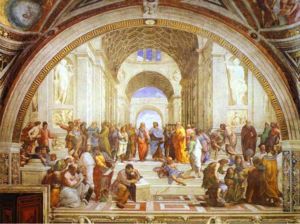
| + | [[Image:School_of_Athens.jpg|thumb|300px|Various influential Greek philosophers in ''The School of Athens'' by [[Raphael]].]] | ||
'''Hellenism''' is the idea of a unitary [[Ancient Greece|Greek]] culture, as argued by Greek philosophers through the Fourth Century B.C., especially in the post-[[Alexander the Great|Alexander]] Age. | '''Hellenism''' is the idea of a unitary [[Ancient Greece|Greek]] culture, as argued by Greek philosophers through the Fourth Century B.C., especially in the post-[[Alexander the Great|Alexander]] Age. | ||
| Line 12: | Line 13: | ||
“And if a man should partake of our culture, let him be called Hellene." - Isocrates, 4th Century B.C. | “And if a man should partake of our culture, let him be called Hellene." - Isocrates, 4th Century B.C. | ||
| + | |||
| + | == See also == | ||
| + | |||
| + | *[[Greek influence on Western Culture]] | ||
== External links == | == External links == | ||
Latest revision as of 01:00, January 6, 2025

Various influential Greek philosophers in The School of Athens by Raphael.
Hellenism is the idea of a unitary Greek culture, as argued by Greek philosophers through the Fourth Century B.C., especially in the post-Alexander Age.
Hellenism and the early Christian church
Video:
Quote
“And if a man should partake of our culture, let him be called Hellene." - Isocrates, 4th Century B.C.
See also
External links
- What Is Hellenism?, National Hellenic Museum
- Hellenistic age, Britannica
Video: