Difference between revisions of "Harvey Milk"
| Line 26: | Line 26: | ||
===White Night riots=== | ===White Night riots=== | ||
:{{See also|Jonestown_Massacre#The_white_night}} | :{{See also|Jonestown_Massacre#The_white_night}} | ||
| + | In May 1978, Deborah Layton, a Temple financial secretary and one of Jim Jones’ most trusted aides, traveled from Jonestown to Georgetown, Guyana and went to the American Embassy, where she sought refuge. An airline ticket from her family was waiting for her, and after giving a statement to Embassy Consul Richard McCoy about conditions in Jonestown, Blakey left for the United States. About a month later, she issued a longer [[affidavit]] with more details on her earlier allegations. | ||
| + | |||
| + | The affidavit became an important document in the campaign of the [[Concerned Relatives]] to bring attention to their cause, and helped Congressman [[Leo Ryan]] in his decision to go to Guyana six months later. For the same reason, the affidavit – and its author – became anathema in the Jonestown community.<ref>https://jonestown.sdsu.edu/?page_id=13072</ref> | ||
==Gay teachers== | ==Gay teachers== | ||
Revision as of 06:06, February 5, 2019

Harvey Bernard Milk (May 22, 1930 – November 27, 1978) was a Progressive Democrat politician and the first openly homosexual man to be elected to public office in California. He was elected to the San Francisco Board of Supervisors with the endorsement and active door-knocking campaign by the Peoples Temple.
People's Temples
Milk first became acquainted with the Peoples Temple while running for the California State Assembly. Temple member Sharon Amos organized the Temple's leafleting campaign for Milk. Amos requested the delivery of 30,000 pamphlets and Milk's campaign delivered them to the Temple.[2]
Milk and Gov. Jerry Brown spoke at several People's Temple events.[3].[4] Milk, a perennial candidate for office until he finally won a supervisor’s seat in 1977, aggressively sought Jones’s political blessing. "Our paths have crossed," Milk wrote Jones during an earlier campaign for supervisor, in a letter filled with the kind of awed reverence that the cult leader demanded from his followers. "They will stay crossed. It is a fight that I will walk with you into . . . The first time I heard you, you made a statement: 'Take one of us, and you must take all of us.'"[5]
Milk was enthusiastically received at the Temple, and he always sent glowing thank-you notes to Jim Jones after visits. Milk ally Richard Boyle recalls "[b]oth Milk and I spoke at the temple to the cheers of thousands of Jones' followers and won their support." [6] Boyle explained that it was vital for both his campaign and Milk's that they be received well at the Temple "because Jones was not only Moscone's appointed head of the Housing Authority but also could turn out an army of volunteers."
Following one visit, Milk wrote to Jones: "Rev Jim, It may take me many a day to come back down from the high that I reach today. I found something dear today. I found a sense of being that makes up for all the hours and energy placed in a fight. I found what you wanted me to find. I shall be back. For I can never leave."[7][8]
When investigations into the Temple's activities began, Willie Brown said at a rally in support of Jones attended by Milk and others,[9] "[h]e is a rare human being" and "he cares about people...Rev. Jim Jones is that person who can be helpful when all appears to be lost and hope is just about gone."[10] In a hand-written note, Milk wrote to Jones "my name is cut into stone in support of you - and your people."
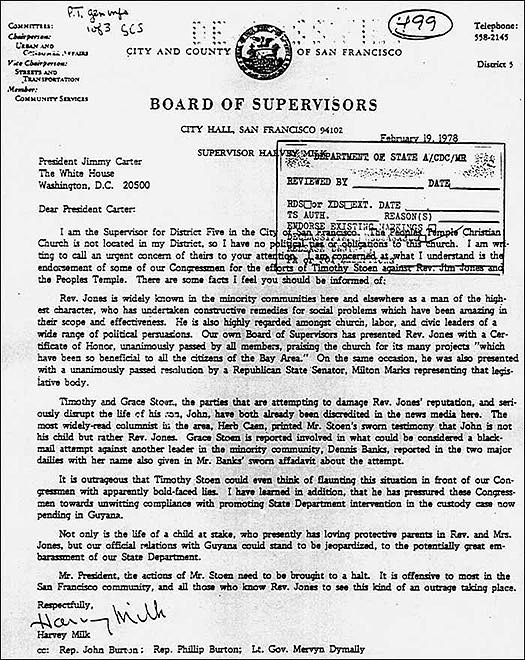
Milk wrote a letter in support of the Temple's founder to President Jimmy Carter, defending the Rev. Jim Jones "as a man of the highest character," and stating that Temple critics were trying to "damage Rev. Jones' reputation" with "apparent bold-faced lies."[11]
Milk remained popular among temple members. Two months before the tragedy Temple members sent over fifty letters of sympathy to Milk following the suicide of Milk's gay lover, Jack Lira, hung himself on the back porch. One letter ended, "You have our deepest sympathy in your loss and we would be glad to have you with us [in Jonestown], even for only a short visit." Temple member Sharon Amos wrote "I had the opportunity in San Francisco when we were there to get to know you and thought very highly of your commitment to social actions and the betterment of your community." She also wrote "I hope you will be able to visit us here sometime in Jonestown. Believe it or not, it is a tremendously sophisticated community, though it is in a jungle." Amos later murdered her children with a knife at the behest of Jones in Georgetown, Guyana and subsequently committed suicide.[12]
Assassination
After the tragedy, Mayor George Moscone initially defended his appointment of Jones, stating that, in 1975, Jones' reputation was that of a man who believed in social justice and racial equality, and that there was evidence that the Peoples Temple had initiated programs for drug and alcohol rehabilitation. When asked by a reporter whether he felt in any way culpable for the events, Moscone became angry at the reporter and stated "I'm not taking any responsibility, it's not mine to shoulder."[13] Milk stated that "Guyana was a great experiment that didn't work. I don't know, maybe it did." [14]
On November 27, 1978, nine days after the Jonestown Massacre, Milk and Mayor George Moscone were shot and killed by Dan White, a disgruntled, Democratic former Supervisor.
At his trial, Dan White's lawyers insisted that his judgment had been impaired by depression caused by a poor diet. This argument (dubbed the "twinkie defense" by the media) led to a lenient sentence, provoking the White Night riots within San Francisco's homosexual community.
White Night riots
- See also: Jonestown_Massacre#The_white_night
In May 1978, Deborah Layton, a Temple financial secretary and one of Jim Jones’ most trusted aides, traveled from Jonestown to Georgetown, Guyana and went to the American Embassy, where she sought refuge. An airline ticket from her family was waiting for her, and after giving a statement to Embassy Consul Richard McCoy about conditions in Jonestown, Blakey left for the United States. About a month later, she issued a longer affidavit with more details on her earlier allegations.
The affidavit became an important document in the campaign of the Concerned Relatives to bring attention to their cause, and helped Congressman Leo Ryan in his decision to go to Guyana six months later. For the same reason, the affidavit – and its author – became anathema in the Jonestown community.[15]
Gay teachers
Milk's biggest victory was the month of his death. He was instrumental in the defeat of The Briggs Initiative that would have barred open homosexuals from teaching positions in his district. Although public opinion polls predicted its passage, he was able to mobilize enough people to vote no. Then-governor Ronald Reagan publicly opposed the Proposition which progressives used to enable its defeat.
Sexual Predator
Milk was working to help at-risk youths. At age 33, he sodomized a 16-year-old boy named Jack McKinley.[16][17]
Progressive legacy
May 22 is designated Harvey Milk day by the state of California. The U.S. Postal Service has created a stamp in his honor.
References
- ↑ https://www.theamericanconservative.com/dreher/jim-jones-harvey-milk-cult-city-secret-history/
- ↑ Shilts, Randy, The Mayor of Castro Street: The Life and Times of Harvey Milk, St. Martin's Press. 1982 ISBN|978-0-312-52330-5, page 234
- ↑ "Another Day of Death." Time Magazine. 11 December 1978 Template:Webarchive
- ↑ Johnson, Tom, "Politicians Try to Explain Ties To Jones, Washington Star Ledger (Time-Life News Service), November 23, 1978
- ↑ A Lavender Look at the Temple: A Gay Perspective of the Peoples Temple, Michael Bellefountaine, Dora Bellefountaine, iUniverse, 2011.
- ↑ Boyle, Richard David, Local writer tells inside story of "Milk", Inland Valley Daily Bulletin, December 17, 2008 Template:Webarchive
- ↑ VanDeCarr, Paul "Death of dreams: in November 1978, Harvey Milk's murder and the mass suicides at Jonestown nearly broke San Francisco's spirit.", The Advocate, November 25, 2003
- ↑ Sawyer, Mary My Lord, What a Mourning:’ Twenty Years Since Jonestown, Jonestown Institute at SDSU Template:Webarchive
- ↑ Reiterman, Tim, and John Jacobs. Raven: The Untold Story of Rev. Jim Jones and His People. Dutton, 1982. ISBN 978-0-525-24136-2. page 327
- ↑ Richardson, James, Willie Brown A Biography, University of California Press, 1996, p. 251 Template:Webarchive
- ↑ Milk, Harvey Letter Addressed to President Jimmy Carter, Dated February 19, 1978 Template:Webarchive
- ↑ (Tim Reiterman (1982) "Raven (book)|Raven: The Untold Story of Rev. Jim Jones and His People" ISBN|978-0-525-24136-2 pp. 544-5)
- ↑ Burns, Jerry, "Willie Brown Defends Former Ties to Rev. Jones", San Francisco Chronicle, November 21, 1978
- ↑ Crewdson, John, "Harvey Milk, Led Coast Homosexual Right Fight", New York Times, November 28, 1978
- ↑ https://jonestown.sdsu.edu/?page_id=13072
- ↑ Would Meghan's Law Apply To Harvey Milk, Politicsforum.org
- ↑ Matt Barber (28 Oct 2013). Sexual Predator Honored With U.S. Postage Stamp. Americans for Truth. Retrieved on 31 Jul 2017. “As a 33-year-old homosexual man, Harvey Milk entered into a homosexual relationship with a 16-year-old boy, according to his late biographer. The age-of-consent in California was 18.”