Product rule
Jump to navigation
Jump to search
| This article/section deals with mathematical concepts appropriate for late high school or early college. |

The Product Rule is a rule in calculus pertaining to the derivative of two variables or functions. The Leibniz notation is as follows:
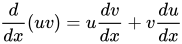
The product rule in words is the derivative of uv is u multiplied by the derivative of v plus the derivative of u multiplied by v. The commutative property allows the terms to be interchanged, which occasionally leads to introduction in reverse.
Example
Let f(x) be the function:

To find its derivative, we split f(x) in two and apply the product rule with u equal 3x and v equal to the sine term:

Rules for finding derivatives
- Power rule
- Constant-multiple rule
- sum rule
- Chain rule
- Product rule
- Quotient rule