Sine
Sine is a trigonometric function describing the ratio between the opposite side and the hypotenuse in a right triangle. As a function it is usually abbreviated sin.
The sine of something is generally calculated in radians, a means of measuring angles determined by the measure of the arc of a circle cut by such an angle, divided by the length of the radius of the circle, so that a full 360° angle would be 2π radians, 180° would be π, 90° would be <math>\frac{\pi}{2}</math> radians, and so on.
Sine Graph
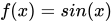
The basic sine graph, <math>f(x)=sin(x)</math>, where x is in radians, is as follows:
|
|
That would be a full period of the graph - as 2π radians is equivalent to one circle. The graph continues in that pattern.
Famous Sines
Because of the known relationship of the sides of a right triangle with the angles 30°, 45°, or 60°, certain values of sine are calculable using exact values in the form of square roots and fractions involving square roots. These include:

- <math>\sin\frac{\pi}{60}=\sin 3^\circ=\frac{(2-\sqrt{12})\sqrt{5+\sqrt5}+(\sqrt{10}-\sqrt2)(\sqrt3+1)}{16}\,</math>
- <math>\sin\frac{\pi}{30}=\sin 6^\circ=\frac{\sqrt{30-\sqrt{180}}-\sqrt5-1}{8}\,</math>
- <math>\sin\frac{\pi}{20}=\sin 9^\circ=\frac{\sqrt{10}+\sqrt2-\sqrt{20-\sqrt{80}}}{8}\,</math>
- <math>\sin\frac{\pi}{15}=\sin 12^\circ=\frac{\sqrt{10+\sqrt{20}}+\sqrt{3}-\sqrt{15}}{8}\,</math>
- <math>\sin\frac{\pi}{12}=\sin 15^\circ=\frac{\sqrt{6}-\sqrt{2}}{4}</math>
- <math>\sin\frac{\pi}{10}=\sin 18^\circ=\frac{\sqrt5-1}{4}=\tfrac{1}{2}\varphi^{-1}\,</math>
- <math>\sin\frac{7\pi}{60}=\sin 21^\circ=\frac{(2+\sqrt{12})\sqrt{5-\sqrt5}-(\sqrt{10}+\sqrt2)(\sqrt3-1)}{16}\,</math>
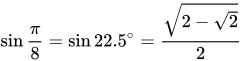
- <math>\sin\frac{\pi}{8}=\sin 22.5^\circ=\frac{\sqrt{2-\sqrt2}}{2}</math>
- <math>\sin\frac{2\pi}{15}=\sin 24^\circ=\frac{\sqrt3+\sqrt{15}-\sqrt{10-\sqrt{20}}}{8}\,</math>
- <math>\sin\frac{3\pi}{20}=\sin 27^\circ=\frac{\sqrt{20+\sqrt{80}}-\sqrt{10}+\sqrt2}{8}\,</math>
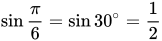
- <math>\sin\frac{\pi}{6}=\sin 30^\circ=\frac{1}{2}</math>
- <math>\sin\frac{11\pi}{60}=\sin 33^\circ=\frac{(\sqrt{12}-2)\sqrt{5+\sqrt5}+(\sqrt{10}-\sqrt2)(\sqrt3+1)}{16}\,</math>
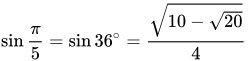
- <math>\sin\frac{\pi}{5}=\sin 36^\circ=\frac{\sqrt{10-\sqrt{20}}}{4}\,</math>
- <math>\sin\frac{13\pi}{60}=\sin 39^\circ=\frac{(2-\sqrt{12})\sqrt{5-\sqrt5}+(\sqrt{10}+\sqrt2)(\sqrt3+1)}{16}\,</math>
- <math>\sin\frac{7\pi}{30}=\sin 42^\circ=\frac{\sqrt{30+\sqrt{180}}-\sqrt5+1}{8}\,</math>
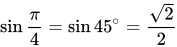
- <math>\sin\frac{\pi}{4}=\sin 45^\circ=\frac{\sqrt{2}}{2}</math>
Relationship to cosine and cosecant
A mathematical identity involving sine is:

<math>\sin \theta = \cos \left(\frac{\pi}{2} - \theta \right) = \frac{1}{\csc \theta}\,</math>