Difference between revisions of "Europa"
Jump to navigation
Jump to search

(see talk) |
|||
| Line 1: | Line 1: | ||
| + | [[Image:Map Europa.jpg|309px|right]] | ||
| + | |||
:1) [[Europe|Europa]]: The name for the continent of [[Europe]] in many European languages; including [[German]], [[Spanish]] and [[Italian]] | :1) [[Europe|Europa]]: The name for the continent of [[Europe]] in many European languages; including [[German]], [[Spanish]] and [[Italian]] | ||
:2) [[Europa_(moon)|Europa]]: The second innermost of the [[Galileo|Galilean]] moons of [[Jupiter]] | :2) [[Europa_(moon)|Europa]]: The second innermost of the [[Galileo|Galilean]] moons of [[Jupiter]] | ||
| − | :3) [[Princess_Europa|Europa]]: The [[Phoenicia|Phoenician]] princess who, according to legend, gave Europe its name | + | :3) [[Princess_Europa|Europa]]: The [[Phoenicia|Phoenician]] princess who, according to legend, gave Europe its name. |
| + | |||
| + | Europe is the birthplace of Western [[culture]]. | ||
| + | |||
| + | == See also == | ||
| + | *[[Europa (moon)]] | ||
| + | |||
| + | <br> | ||
| + | [[Image:Europa true color.jpg|200px|left]] | ||
[[Category:Dictionary]] | [[Category:Dictionary]] | ||
Revision as of 12:54, July 8, 2008

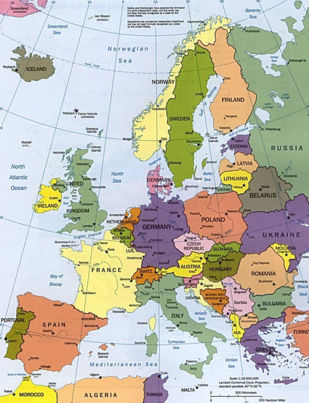
- 1) Europa: The name for the continent of Europe in many European languages; including German, Spanish and Italian
- 2) Europa: The second innermost of the Galilean moons of Jupiter
- 3) Europa: The Phoenician princess who, according to legend, gave Europe its name.
Europe is the birthplace of Western culture.
See also
