Difference between revisions of "Pythagorean triple"
(insp) |
(add table) |
||
| Line 12: | Line 12: | ||
:<math> a=m^2-n^2,\ \,b=2mn,\ \,c=m^2+n^2</math> | :<math> a=m^2-n^2,\ \,b=2mn,\ \,c=m^2+n^2</math> | ||
There are many other formulas for generating such triples. | There are many other formulas for generating such triples. | ||
| + | |||
| + | The two above formulas are related. This table is intended as an aid to understanding the behavior of Euclid formula: | ||
| + | E(m,n) -> (m<sup>2</sup>-n<sup>2</sup> , 2mn , m<sup>2</sup>+n<sup>2</sup>) | ||
| + | {| | ||
| + | | E(m,n) | ||
| + | |- | ||
| + | |n | ||
| + | | 1 | ||
| + | | 2 | ||
| + | | 3 | ||
| + | | 4 | ||
| + | | 5 | ||
| + | | 6 | ||
| + | | 7 | ||
| + | | 8 | ||
| + | |- | ||
| + | |m | ||
| + | |- | ||
| + | |2 | ||
| + | |(3,4,5) | ||
| + | |- | ||
| + | | | ||
| + | |PPT | ||
| + | |- | ||
| + | |3 | ||
| + | |(8,6,10) | ||
| + | |(5,12,13) | ||
| + | |- | ||
| + | | | ||
| + | |T2X E(2,1) | ||
| + | |PPT | ||
| + | |- | ||
| + | |4 | ||
| + | |(15,8,17) | ||
| + | |(12,16,20) | ||
| + | |(7,24,25) | ||
| + | |- | ||
| + | | | ||
| + | |PPT | ||
| + | |Note 1 | ||
| + | |PPT | ||
| + | |- | ||
| + | |5 | ||
| + | |(24,10,26) | ||
| + | |(21,20,29) | ||
| + | |(16,30,34) | ||
| + | |(9,40,41) | ||
| + | |- | ||
| + | | | ||
| + | |T2X E(3,2) | ||
| + | |PPT | ||
| + | |T2X E(4,1) | ||
| + | |PPT | ||
| + | |- | ||
| + | |6 | ||
| + | |(35,12,37) | ||
| + | |(32,24,40) | ||
| + | |(27,36,45) | ||
| + | |(20,48,52) | ||
| + | |(11,60,61) | ||
| + | |- | ||
| + | | | ||
| + | |PPT | ||
| + | |4X E(3,1) | ||
| + | |9X E(2,1) | ||
| + | |4X E(3,2) | ||
| + | |PPT | ||
| + | |- | ||
| + | |7 | ||
| + | |(48,14,50) | ||
| + | |(45,28,53) | ||
| + | |(40, 42, 58) | ||
| + | |(33,56, 65) | ||
| + | |(24,70,74) | ||
| + | |(13,84,85) | ||
| + | |- | ||
| + | | | ||
| + | |T2X E(4,3) | ||
| + | |PPT | ||
| + | |T2X E(5,2) | ||
| + | |PPT | ||
| + | |T2X E(6,1) | ||
| + | |PPT | ||
| + | |- | ||
| + | |8 | ||
| + | |(63,16,65) | ||
| + | |(60,32,68) | ||
| + | |(55,48,73) | ||
| + | |(48,64,80) | ||
| + | |(39, 80, 89) | ||
| + | |(28, 96, 100) | ||
| + | |(15, 112, 113) | ||
| + | |- | ||
| + | | | ||
| + | |PPT | ||
| + | |4X E(4,1) | ||
| + | |PPT | ||
| + | |16X E(2,1) | ||
| + | |PPT | ||
| + | |4X E(4,3) | ||
| + | |PPT | ||
| + | |- | ||
| + | |9 | ||
| + | |(80,18,82) | ||
| + | |(77, 36, 85) | ||
| + | |(72, 54, 90) | ||
| + | |(65, 72, 97) | ||
| + | |(56, 90, 106) | ||
| + | |(45, 108, 117) | ||
| + | |(32, 126, 130) | ||
| + | |(17, 144, 145) | ||
| + | |- | ||
| + | | | ||
| + | |T2X E(5,4) | ||
| + | |PPT | ||
| + | |Note 2 | ||
| + | |PPT | ||
| + | |T2X E(7,2) | ||
| + | |9X E(3,2) | ||
| + | |T2X E(8,1) | ||
| + | |PPT | ||
| + | |- | ||
| + | |} | ||
| + | |||
| + | Where the following are where both kinds of relationships apply (see below): | ||
| + | *Note 1 at E(4,2): 4X E(2,1) and T2X E(3,1) | ||
| + | *Note 2 at E(9,3): 9X E(3,1) and T2X E(6,3) | ||
| + | |||
| + | Table legend: Each triple is noted as either a PPT (Primitive Pythagorean Triple) or is noted by being related to some other lower m-value triple by one of two relationships. | ||
| + | * 4X, 9X, etc. is where the Euclid parameters are a simple multiple of some lower m-value cell (i.e. m and n have a common factor, i.e. a GCD greater than one) and thus the triple values are multiplied by the square of that factor. | ||
| + | * T2X indicates a "2X" relation with lower m-value cell. The relationship is that the lower m-value triple (a,b,c) results in this cell's values being (2b, 2a, 2c), i.e. all three triple values are doubled and a and b are transposed. If the lower-m value cell is E(m,n) then this new cell is E(m+n, m-n). E.g. For, E(5,2) which results in (21,20,29), the T2X is E(5+2, 5-2) or E(7,3) resulting in (40,42,58). When searching for the lower m-value cell, one can use the inverse formula: E((m+n)/2, (m-n)/2). E.g. when starting with E(7,3) and looking backwards, one finds E((7+3)/2, (7-3)/2)) or just E(5,2). In this case, the higher m-value parameters must be either both even or both odd. | ||
| + | |||
| + | See the next section for comments on the n=1 column and the n=m-1 diagonal. | ||
| + | |||
| + | Note that in the table above, as you go across a row from left to right (constant '''m'''), '''b''' become greater than '''a''' at '''n''' of (√2-1)* '''m''' or '''n''' = 0.41 * '''m'''. | ||
| + | |||
| + | The "odd" equation corresponds to the Euclid formula for the n=m-1 diagonal and the "even" equation corresponds to Euclid's formula where n=1 column in the table of the previous section. | ||
| + | |||
| + | More formally: given a positive integer ''n'', the triple can be generated by the following two procedures: | ||
| + | (see http://www.mcs.surrey.ac.uk/Personal/R.Knott/Pythag/pythag.html ) | ||
| + | |||
| + | :<math> a= 2n + 1 \,:\, b=2n(n + 1) \,:\, c = 2n(n + 1) + 1 </math> | ||
| + | |||
| + | Example: When ''n'' = 2, the triple produced is 5, 12, and 13. | ||
| + | (This formula is actually the same as method I, substituting ''m'' with 2''n'' + 1.) | ||
| + | |||
| + | Alternatively, one can generate triples from even integers using the following formulas. Given that ''m'' is an positive even number, | ||
| + | |||
| + | :<math> a= 2m \,:\, b=m^2 - 1 \,:\, c = m^2 + 1 </math> | ||
| + | |||
| + | Example: When ''m'' = 4 the triple produced is 8, 15, and 17 | ||
| + | (This formula is another specific case of method I, substituting ''n'' with 1). | ||
| + | |||
==Notes== | ==Notes== | ||
{{reflist}} | {{reflist}} | ||
[[Category:Mathematics]] | [[Category:Mathematics]] | ||
Revision as of 02:50, February 11, 2017
Pythagorean triple is a triple of integers that follow the following formula:

It is similar to the Pythagorean Theorem which states the same for a right triangle for non-integer sides. Some of the simplest triples are:
- and
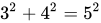

Studying these two triples, the reader may have the insight that
- and


This leads to a trivial sequence that generates some but not all possible triples is based on the positive integers starting with Failed to parse (MathML with SVG or PNG fallback (recommended for modern browsers and accessibility tools): Invalid response ("Math extension cannot connect to Restbase.") from server "https://wikimedia.org/api/rest_v1/":): {\displaystyle a=3} :[1]:
- If Failed to parse (MathML with SVG or PNG fallback (recommended for modern browsers and accessibility tools): Invalid response ("Math extension cannot connect to Restbase.") from server "https://wikimedia.org/api/rest_v1/":): {\displaystyle a} is odd, then Failed to parse (MathML with SVG or PNG fallback (recommended for modern browsers and accessibility tools): Invalid response ("Math extension cannot connect to Restbase.") from server "https://wikimedia.org/api/rest_v1/":): {\displaystyle b=\frac{a^2}{2}-\frac{1}{2}} and Failed to parse (MathML with SVG or PNG fallback (recommended for modern browsers and accessibility tools): Invalid response ("Math extension cannot connect to Restbase.") from server "https://wikimedia.org/api/rest_v1/":): {\displaystyle c=b+1}
- If Failed to parse (MathML with SVG or PNG fallback (recommended for modern browsers and accessibility tools): Invalid response ("Math extension cannot connect to Restbase.") from server "https://wikimedia.org/api/rest_v1/":): {\displaystyle a} is even, then Failed to parse (MathML with SVG or PNG fallback (recommended for modern browsers and accessibility tools): Invalid response ("Math extension cannot connect to Restbase.") from server "https://wikimedia.org/api/rest_v1/":): {\displaystyle b=\frac{a^2}{4}-1} and Failed to parse (MathML with SVG or PNG fallback (recommended for modern browsers and accessibility tools): Invalid response ("Math extension cannot connect to Restbase.") from server "https://wikimedia.org/api/rest_v1/":): {\displaystyle c=b+2}
Euclid's formula is a fundamental formula for generating all possible Pythagorean triples given an arbitrary pair of integers Failed to parse (MathML with SVG or PNG fallback (recommended for modern browsers and accessibility tools): Invalid response ("Math extension cannot connect to Restbase.") from server "https://wikimedia.org/api/rest_v1/":): {\displaystyle m} and Failed to parse (MathML with SVG or PNG fallback (recommended for modern browsers and accessibility tools): Invalid response ("Math extension cannot connect to Restbase.") from server "https://wikimedia.org/api/rest_v1/":): {\displaystyle n} with Failed to parse (MathML with SVG or PNG fallback (recommended for modern browsers and accessibility tools): Invalid response ("Math extension cannot connect to Restbase.") from server "https://wikimedia.org/api/rest_v1/":): {\displaystyle m>n>0} . The formula states that the following integers form a Pythagorean triple:
- Failed to parse (MathML with SVG or PNG fallback (recommended for modern browsers and accessibility tools): Invalid response ("Math extension cannot connect to Restbase.") from server "https://wikimedia.org/api/rest_v1/":): {\displaystyle a=m^2-n^2,\ \,b=2mn,\ \,c=m^2+n^2}
There are many other formulas for generating such triples.
The two above formulas are related. This table is intended as an aid to understanding the behavior of Euclid formula: E(m,n) -> (m2-n2 , 2mn , m2+n2)
| E(m,n) | ||||||||
| n | 1 | 2 | 3 | 4 | 5 | 6 | 7 | 8 |
| m | ||||||||
| 2 | (3,4,5) | |||||||
| PPT | ||||||||
| 3 | (8,6,10) | (5,12,13) | ||||||
| T2X E(2,1) | PPT | |||||||
| 4 | (15,8,17) | (12,16,20) | (7,24,25) | |||||
| PPT | Note 1 | PPT | ||||||
| 5 | (24,10,26) | (21,20,29) | (16,30,34) | (9,40,41) | ||||
| T2X E(3,2) | PPT | T2X E(4,1) | PPT | |||||
| 6 | (35,12,37) | (32,24,40) | (27,36,45) | (20,48,52) | (11,60,61) | |||
| PPT | 4X E(3,1) | 9X E(2,1) | 4X E(3,2) | PPT | ||||
| 7 | (48,14,50) | (45,28,53) | (40, 42, 58) | (33,56, 65) | (24,70,74) | (13,84,85) | ||
| T2X E(4,3) | PPT | T2X E(5,2) | PPT | T2X E(6,1) | PPT | |||
| 8 | (63,16,65) | (60,32,68) | (55,48,73) | (48,64,80) | (39, 80, 89) | (28, 96, 100) | (15, 112, 113) | |
| PPT | 4X E(4,1) | PPT | 16X E(2,1) | PPT | 4X E(4,3) | PPT | ||
| 9 | (80,18,82) | (77, 36, 85) | (72, 54, 90) | (65, 72, 97) | (56, 90, 106) | (45, 108, 117) | (32, 126, 130) | (17, 144, 145) |
| T2X E(5,4) | PPT | Note 2 | PPT | T2X E(7,2) | 9X E(3,2) | T2X E(8,1) | PPT |
Where the following are where both kinds of relationships apply (see below):
- Note 1 at E(4,2): 4X E(2,1) and T2X E(3,1)
- Note 2 at E(9,3): 9X E(3,1) and T2X E(6,3)
Table legend: Each triple is noted as either a PPT (Primitive Pythagorean Triple) or is noted by being related to some other lower m-value triple by one of two relationships.
- 4X, 9X, etc. is where the Euclid parameters are a simple multiple of some lower m-value cell (i.e. m and n have a common factor, i.e. a GCD greater than one) and thus the triple values are multiplied by the square of that factor.
- T2X indicates a "2X" relation with lower m-value cell. The relationship is that the lower m-value triple (a,b,c) results in this cell's values being (2b, 2a, 2c), i.e. all three triple values are doubled and a and b are transposed. If the lower-m value cell is E(m,n) then this new cell is E(m+n, m-n). E.g. For, E(5,2) which results in (21,20,29), the T2X is E(5+2, 5-2) or E(7,3) resulting in (40,42,58). When searching for the lower m-value cell, one can use the inverse formula: E((m+n)/2, (m-n)/2). E.g. when starting with E(7,3) and looking backwards, one finds E((7+3)/2, (7-3)/2)) or just E(5,2). In this case, the higher m-value parameters must be either both even or both odd.
See the next section for comments on the n=1 column and the n=m-1 diagonal.
Note that in the table above, as you go across a row from left to right (constant m), b become greater than a at n of (√2-1)* m or n = 0.41 * m.
The "odd" equation corresponds to the Euclid formula for the n=m-1 diagonal and the "even" equation corresponds to Euclid's formula where n=1 column in the table of the previous section.
More formally: given a positive integer n, the triple can be generated by the following two procedures: (see http://www.mcs.surrey.ac.uk/Personal/R.Knott/Pythag/pythag.html )
- Failed to parse (MathML with SVG or PNG fallback (recommended for modern browsers and accessibility tools): Invalid response ("Math extension cannot connect to Restbase.") from server "https://wikimedia.org/api/rest_v1/":): {\displaystyle a= 2n + 1 \,:\, b=2n(n + 1) \,:\, c = 2n(n + 1) + 1 }
Example: When n = 2, the triple produced is 5, 12, and 13. (This formula is actually the same as method I, substituting m with 2n + 1.)
Alternatively, one can generate triples from even integers using the following formulas. Given that m is an positive even number,
- Failed to parse (MathML with SVG or PNG fallback (recommended for modern browsers and accessibility tools): Invalid response ("Math extension cannot connect to Restbase.") from server "https://wikimedia.org/api/rest_v1/":): {\displaystyle a= 2m \,:\, b=m^2 - 1 \,:\, c = m^2 + 1 }
Example: When m = 4 the triple produced is 8, 15, and 17 (This formula is another specific case of method I, substituting n with 1).