Difference between revisions of "Europa"
Jump to navigation
Jump to search

m (Reverted edits by TomMoore (Talk); changed back to last version by Joaquín Martínez) |
|||
| Line 1: | Line 1: | ||
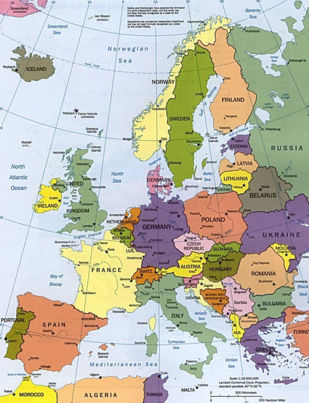
[[Image:Map Europa.jpg|309px|right]] | [[Image:Map Europa.jpg|309px|right]] | ||
| − | '''Europa''' is the name in many languages (German, Spanish, Italian,...) for [[Europe]], which is one of the | + | '''Europa''' is the name in many languages (German, Spanish, Italian,...) for [[Europe]], which is one of the seven continents of [[Earth]]. [[Asia]], [[North America]], [[South America]], [[Africa]], [[Antartica]], and [[Australia]] are the others. It is also the name of one of the Galilean moons of [[Jupiter]]. Europa is named for the Phoenician princess who, according to legend, gave Europe its name. |
Europe is the birthplace of Western [[culture]]. | Europe is the birthplace of Western [[culture]]. | ||
Revision as of 04:41, June 5, 2008

Europa is the name in many languages (German, Spanish, Italian,...) for Europe, which is one of the seven continents of Earth. Asia, North America, South America, Africa, Antartica, and Australia are the others. It is also the name of one of the Galilean moons of Jupiter. Europa is named for the Phoenician princess who, according to legend, gave Europe its name.
Europe is the birthplace of Western culture.
See also
