Indefinite integral
| This article/section deals with mathematical concepts appropriate for late high school or early college. |

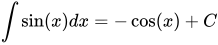
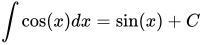
An indefinite integral, or antiderivative, is an integral without upper and lower limits.
Indefinite Integrals
There are an infinite number of antiderivatives for a given function, because each indefinite integral can have an arbitrary constant added to it which disappears upon differentiation. However, the fundamental theorem of calculus relates a definite integral to an indefinite integral by taking its value at the boundary points.
Whenever any expression is integrated the constant of integration, , is always added.

A list of simple antiderivatives
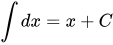
The identity antiderivative:
Polynomial and simple rational
To see the proofs for the first two integrals, see Riemann integral.


The general rule for polynomial expressions is:

Note: . See below for when


Rational
For a more detailed treatment, see Partial fractions in integration.
Rational antiderivatives are much more difficult and follow different rules.