|
This article/section deals with mathematical concepts appropriate for late high school or early college.
|
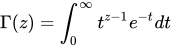
The Gamma funciton is defined as
Relations and values
Factorial
Using integration by parts,

![{\displaystyle =\left[t^{z-1}(-e^{-t})\right]_{0}^{\infty }-\int _{0}^{\infty }(z-1)t^{(z-2)}(-e^{-t})dt.}](https://wikimedia.org/api/rest_v1/media/math/render/svg/aa46dd8e563880bedcbb803f12585120a3f21f7c)
At  ,
,  goes to 0. Using L'Hopital's rule, it's easy to show that
  .
.
So,


Thus,

Using this, and the fact that  , then we can get the factorial function. For
  a positive integer,

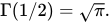
z=1/2
For z=1/2,

Substituting  ,
,


where in the last line we used the fact that  is an even function. The integral is called the Gaussian integral and has a well known value of
  .
.
Thus,