Cylindrical coordinates
Jump to navigation
Jump to search
Cylindrical coordinates refers to a three-dimensional coordinate system used to describe the location of a point in space based on the distance from the origin in the x-y plane , the angle measured in the x-y plane between the point and the x axis , the distance perpendicular to the x-y plane:


In a sense, cylindrical coordinates are polar coordinates with a third dimension added: correspond to the polar coordinates for . This is in contrast to spherical coordinates, where is replaced by an angle, just like x and y are in polar coordinates.


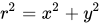
The equations converting the parameters are as follows:


In cylindrical coordinates, the Jacobian is so that .
