Difference between revisions of "Atomic bomb"
Jump to navigation
Jump to search
| Line 2: | Line 2: | ||
The atomic bomb detonates with a massive explosion due to the release of energy in atoms. Specifically, neutrons in a rapid chain reaction split the nuclei of a heavy chemical element, such as plutonium or uranium, to cause the massive release of energy. | The atomic bomb detonates with a massive explosion due to the release of energy in atoms. Specifically, neutrons in a rapid chain reaction split the nuclei of a heavy chemical element, such as plutonium or uranium, to cause the massive release of energy. | ||
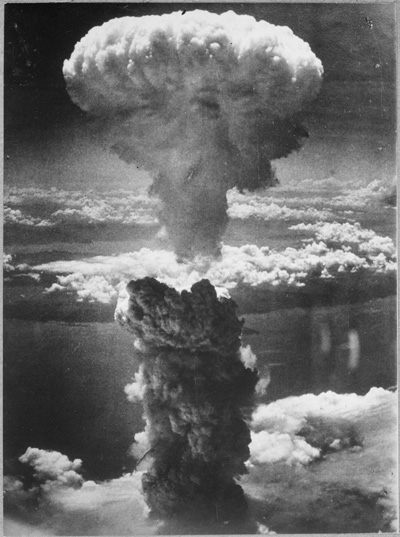
| + | [[Image:Abomb.jpg]] | ||
Revision as of 16:36, December 24, 2006
The atomic bomb was developed first by the Manhattan Project in the early 1940s in the United States as a way to end World War II, which it did when dropped on the Japanese cities of Hiroshima and Nagasaki.
The atomic bomb detonates with a massive explosion due to the release of energy in atoms. Specifically, neutrons in a rapid chain reaction split the nuclei of a heavy chemical element, such as plutonium or uranium, to cause the massive release of energy.