Difference between revisions of "Neutron"
Jump to navigation
Jump to search
(breaking news - read this with a grain of salt) |
(See nucleon.) |
||
| Line 1: | Line 1: | ||
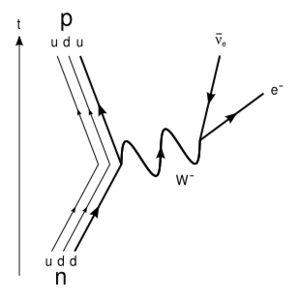
[[Image:310px-Beta Negative Decay svg.png|right|thumb|300px|The [[Feynmann diagram]] of the neutron beta decay process]] | [[Image:310px-Beta Negative Decay svg.png|right|thumb|300px|The [[Feynmann diagram]] of the neutron beta decay process]] | ||
A '''neutron''' is the neutral particle in an [[atom]]'s [[nucleus]]. It is formed when an [[electron]] is crushed into a [[proton]] in a [[neutron star]]; as such, it is the same weight as one proton and one electron together. It is the "glue" that keeps the positive protons in the nucleus from being pushed apart from each other by their like charges. A lack or excess of neutrons causes an atom to become unstable; [[beta decay|beta radiation]] is the loss of one neutron by turning into one proton and one electron. | A '''neutron''' is the neutral particle in an [[atom]]'s [[nucleus]]. It is formed when an [[electron]] is crushed into a [[proton]] in a [[neutron star]]; as such, it is the same weight as one proton and one electron together. It is the "glue" that keeps the positive protons in the nucleus from being pushed apart from each other by their like charges. A lack or excess of neutrons causes an atom to become unstable; [[beta decay|beta radiation]] is the loss of one neutron by turning into one proton and one electron. | ||
| + | |||
| + | See [[nucleon]]. | ||
Revision as of 22:13, September 18, 2007

The Feynmann diagram of the neutron beta decay process
A neutron is the neutral particle in an atom's nucleus. It is formed when an electron is crushed into a proton in a neutron star; as such, it is the same weight as one proton and one electron together. It is the "glue" that keeps the positive protons in the nucleus from being pushed apart from each other by their like charges. A lack or excess of neutrons causes an atom to become unstable; beta radiation is the loss of one neutron by turning into one proton and one electron.
See nucleon.